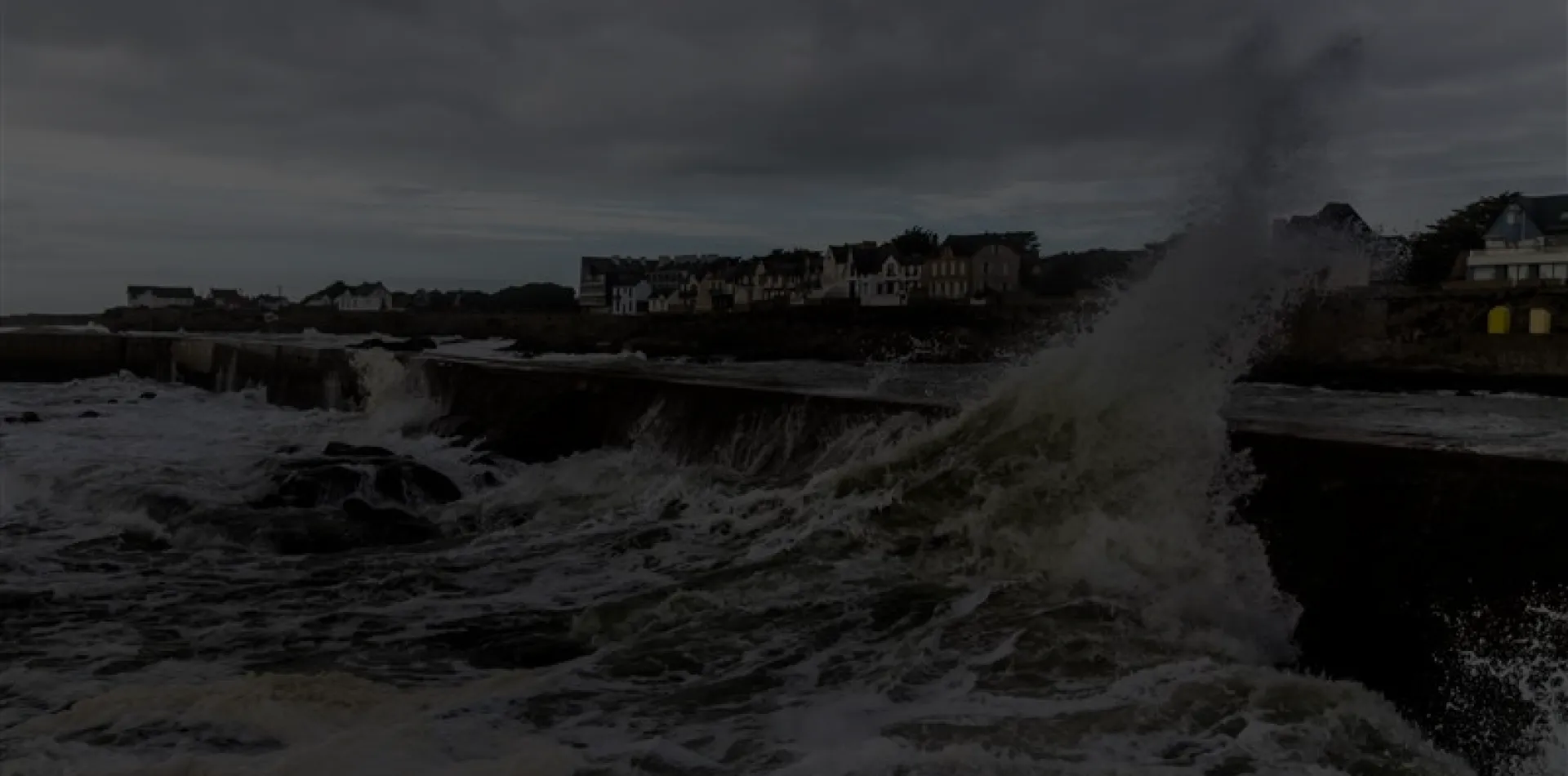





Far from being limited to scale change issues, these critical situations engaging our societies' capacities to respond transform problem definitions to be addressed, forms and modalities of their handling, and the status of actors who appear legitimate to do so.
This seminar is jointly organized by the RISC project (Risks & Societies in the Era of Global Environmental Change: Issues, Knowledge, and Policies) and the COCHAIR project (Collaborative Research Chair "Culture and Risk Mediation") of the PEPR Risks (IRiMa).
Organisation :
- Anne Rasmussen, directrice d’études à l’EHESS
- Soraya Boudia, professeure à l’Université Paris Cité / CNRS
Contact :
Seminar held in French.
Informations :
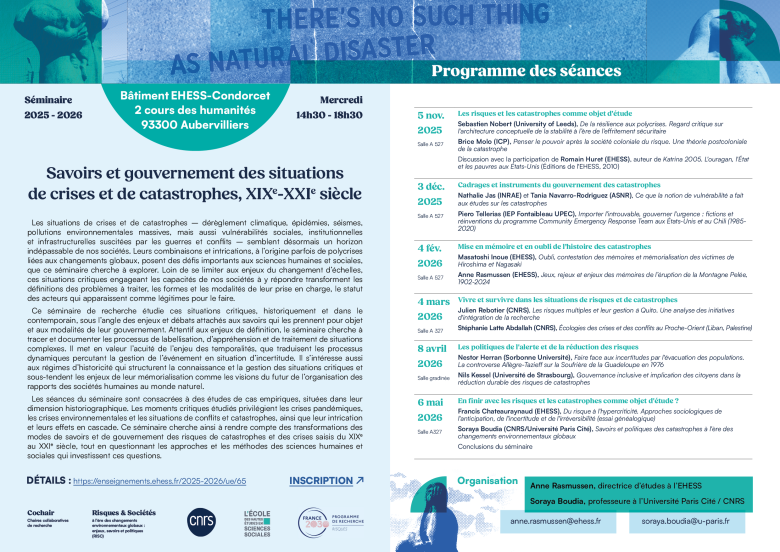
Bâtiment EHESS-Condorcet
2 cours des humanités
93300 Aubervilliers
Wednesday from 14h30 to 18h30
- Nov. 5 2025 - Room A 527
- Dec. 3 2025 - Room A 527
- Feb. 4 2026 - Room A 527
- March 4 2026 - Room A 327
- April 8 2026 - Room gradinée
- May 6 2026 - Room A327
Séminaire EHESS 2025-2026 - Savoirs et gouvernement des situations de crises et de catastrophes, XIXe-XXIe siècle
DR
Session Program
Nov. 5 2025 - Room A 527
Risks and Disasters as Study Objects
- Sebastien Nobert (University of Leeds), From Resilience to Polycrises. Critical Look at the Conceptual Architecture of Stability in the Era of Security Crumbling.
- Brice Molo (ICP), Thinking Power After Colonial Risk Society. A Postcolonial Theory of Disaster
- Discussion with participation of Romain Huret (EHESS), author of Katrina 2005. The Hurricane, the State, and the Poor in the United States (EHESS Editions, 2010).
Déc. 3 2025 - Room A 527
Frameworks and Instruments of Disaster Governance
- Nathalie Jas (INRAE) and Tania Navarro-Rodriguez (ASNR), What the Notion of Vulnerability Did to Disaster Studies.
- Piero Tellerias (IEP Fontainebleau UPEC), Importing the Unfindable, Governing Emergency: Fictions and Reinventions of the Community Emergency Response Team Program in the United States and Chile (1985-2020).
Fév. 4 2026 - Room A 527
Memory and Forgetting of Disaster History
- Masatoshi Inoue (EHESS), Forgetting, Memory Contestation, and Memorialization of Hiroshima and Nagasaki Victims.
- Anne Rasmussen (EHESS), Games, Replays, and Stakes of Memories of Mount Pelée Eruption, 1902-2024.
March 4 2026 - Room A 327
Living and Surviving in Risk and Disaster Situations
- Julien Rebotier (CNRS), Multiple Risks and Their Management in Quito. An Analysis of Research Integration Initiatives.
- Stéphanie Latte Abdallah (CNRS), Ecologies of Crises and Conflicts in the Middle East (Lebanon, Palestine).
April 8 2026 - Room gradinée
Warning and Risk Reduction Policies
- Nestor Herran (Sorbonne University), Facing Uncertainties Through Population Evacuation. The Allègre-Tazieff Controversy on Guadeloupe's Soufrière in 1976.
- Nils Kessel (University of Strasbourg), Inclusive Governance and Citizen Involvement in Sustainable Disaster Risk Reduction.
May 6 2026 - Salle A327
Ending Risks and Disasters as Study Objects?
- Francis Chateauraynaud (EHESS), From Risk to Hypercriticality. Sociological Approaches to Anticipation, Uncertainty, and Irreversibility (genealogical essay).
- Soraya Boudia (CNRS/Paris Cité University), Knowledge and Disaster Policies in the Era of Global Environmental Change
- Seminar conclusions.
This research seminar studies these critical situations, historically and contemporarily, from the angle of issues and debates attached to knowledge taking them as objects and modalities of their governance. Attentive to definition issues, the seminar seeks to trace and document labeling, apprehension, and treatment processes of complex situations. It highlights the acuity of temporality issues, reflected in dynamic processes impacting event management in uncertainty situations. It's also interested in historicity regimes structuring knowledge and management of critical situations and underlying memorialization issues as well as future visions of organizing human societies' relationships with the natural world.
Seminar sessions are devoted to empirical case studies, situated in their historiographic dimension. Critical moments studied privilege pandemic crises, environmental crises, and conflict and disaster situations, as well as their entanglement and cascading effects. This seminar thus seeks to account for transformations in knowledge modes and governance of disaster risks and crises seized from the 19th to 21st century, while questioning social sciences and humanities approaches and methods investing these questions.