


Actualités

Challenges
The impact of climate change on certain natural phenomena now requires the integration of new variables into studies on natural and anthropogenic risks. Climate risk assessments are now essential for quantifying and presenting these risks clearly, thereby facilitating public debate and political decision-making.
The IPCC has detailed the determinants of climate risk, but the associated vulnerability remains a complex issue requiring an integrated approach that takes into account various socio-economic, environmental, and political factors.
This integrated approach requires co-production processes involving scientists and socio-economic stakeholders to develop operational climate services.
The emergence of climate information services has improved access to the data needed for risk assessment, with facilitated access for non-specialist users. However, there is often a mismatch between the spatial and temporal scales covered by these climate services. Furthermore, integrating heterogeneous data from different scientific communities remains a major challenge.
The IRICLIM project brings together key stakeholders with the objective of improving the assessment of climate-related disasters. IRICLIM will focus its efforts on mainland France, with the issue of risk management in overseas regions being covered by the Overseas risks project.
Objective
Faced with climate risks that can be highly variable, emerging, recurrent, progressive, or intense, the IRICLIM project is working to develop new integrated approaches to better anticipate, prevent, and manage these sudden or gradual high-impact risks.
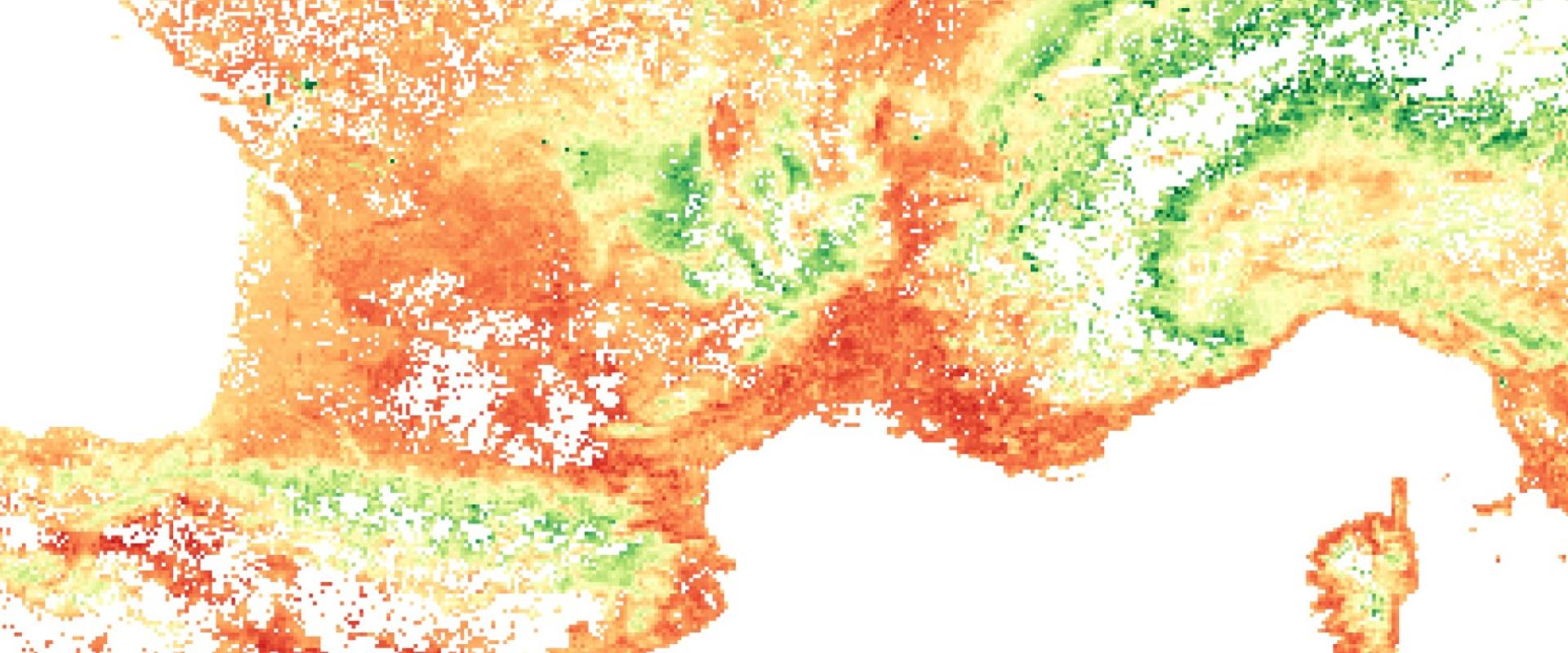
The project is based on the analysis of climate forcings (precipitation, air temperature, humidity, wind speed, incident radiation), their influence on major seasonal geological hazards (clay shrink-swell, floods, fires), and the management of their impacts in collaboration with stakeholders.
The methodologies implemented draw on recent advances in geosciences, climate sciences, and decision support: complex interactions of geological processes and their modeling through high-performance numerical schemes, time series and remote sensing data analysis using deep learning approaches, collaborative and immersive decision-making protocols, etc.
The intended objective is the creation of an integrated climate risk mapping method that will address 4 identified needs:
- Provide a more complete and accessible vision of climate risks, in support of adaptation and mitigation policies.
- Build a framework to structure risk assessments in order to better understand the temporal and spatial dynamics of risks, and to integrate the potential impacts of climate change and human responses.
- Adopt a collective and multidisciplinary approach aimed at:
- Co-producing the knowledge necessary to understand local and regional risks and impacts.
- Demonstrating the feasibility of this approach to assess climate risks and strengthen society's resilience to the impacts of climate change.
- Implementing a common methodology to identify cause-and-effect relationships between climate events, intermediate impacts, and the vulnerability of socio-ecological systems.
- Address technical aspects such as:
- Data accessibility and integration.
- Format harmonization.
Research areas and expected results
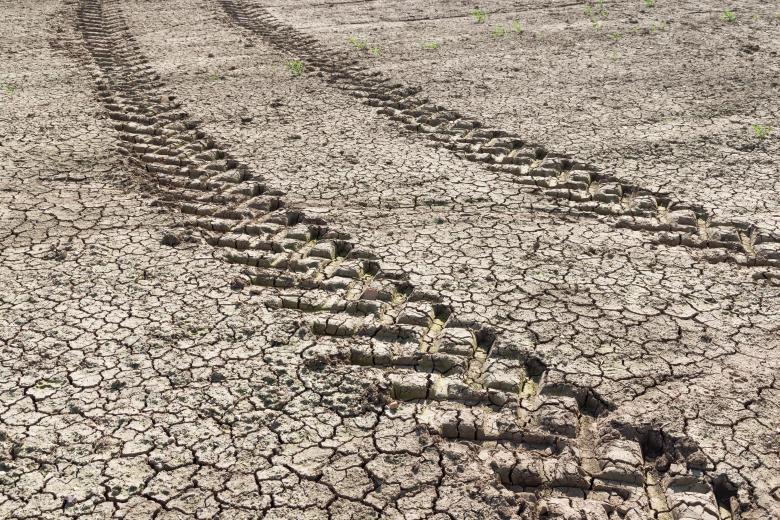
Geotechnical droughts
New methods will be developed to map soils containing swelling clays. Existing drought indicators will be refined for better monitoring of the phenomenon.
This work area aims to improve the mapping of susceptibility to clay shrink-swell and the monitoring of drought intensity.
Various types of data (mineralogical, geochemical, geological, geophysical, etc.) will be combined to produce a regional map of soil susceptibility to this phenomenon.
The method used will consist of:
- Gathering data from different physical sources, with varying spatial resolutions (from field scale to several tens of kilometers) and various formats (mapping type/density).
- Processing this data through numerical methods derived from machine learning.
The initial data used in this project comes from BRGM and open sources. This database will be enriched in various ways:
- Experiments to better understand the response of geophysical methods to the presence of swelling clays (phyllosilicates of the smectite group in particular).
- Drought intensity will be monitored using Météo-France's ISBA surface model, combined with new atmospheric forcing from the AROME forecast model (1.3 km) and the new ARRA atmospheric reanalysis.
- Satellite data will be integrated into the ISBA model to improve the representation of vegetation effects.
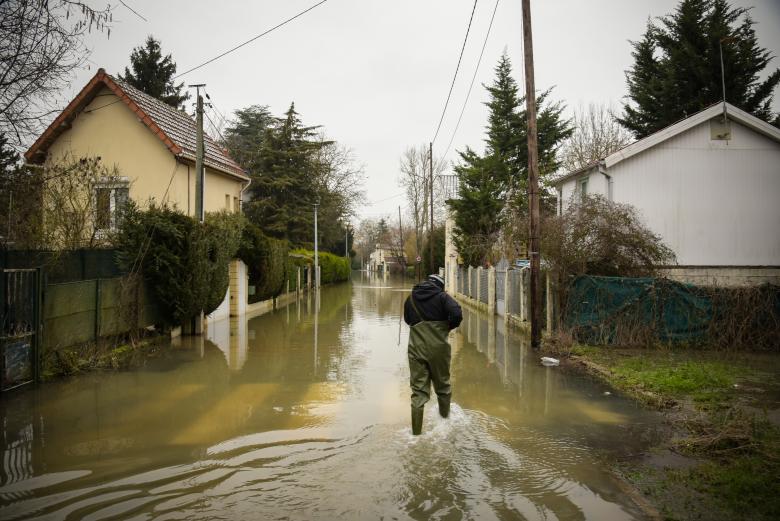
Floods and runoff
New methods will be developed to improve short-term (crisis management) and long-term (adaptation) decision support in order to reduce risks related to floods and runoff.
Floods represent the most widespread natural disaster related to weather conditions. Yet, more than 50% of damages occur outside areas identified as at risk, which are essentially limited to overflows of major watercourses.
Small-scale flood hazards, such as flash floods, local runoff flooding, and mudflows, are still largely underrepresented in currently available decision support tools.
The work conducted on these hazards will be carried out following 2 objectives:
- Improve real-time warning systems through specially designed short-range forecast systems:
- Experiment, at the national scale, with a suite of hydrometeorological forecasts at kilometer resolution for lead times up to 24 hours, designed to issue local flood risk alerts, with better description of forecast uncertainties at different lead times and hydrological scales.
- Developing high-resolution hazard mapping tools:
- Establish a comprehensive framework for modeling and mapping runoff and erosion at the national scale and over long periods (several decades), in order to better identify at-risk areas.
Vegetation fires
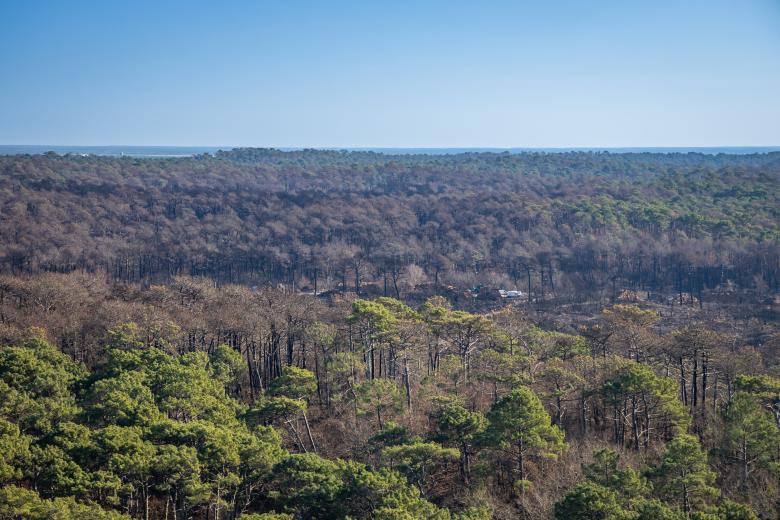
In response to the major fires of 2022, the relevant ministries entrusted several research organizations, such as Météo-France, with developing new fire risk mapping and forecasting tools. Indeed, despite recent advances in remote sensing and fire modeling, accurately predicting the occurrence and intensity of fires remains a challenge.
To fulfill this mission, this work area will develop an integrated framework to predict various aspects of vegetation fire danger, from danger factors (vegetation) to fire activity (occurrence), their characteristics (behavior, spread, convection, and resolved plume), and their immediate impacts on forests and buildings.
This work will be organized into 4 specific objectives:
- Improve the characterization of fuels (forest and agricultural).
- Optimize deterministic and probabilistic models for predicting occurrence and potential behavior.
- Develop an extreme fire simulator including fire-atmosphere interactions.
- Assess the impacts of fires on forests and buildings.
Climate Risk Assessment
In order to design a risk management system, hazards will be redefined through the vulnerabilities created (infrastructure, networks, populations), and decision support methodologies will be developed for the various decision-making organizations.
This work area will follow two main objectives:
- Characterize vulnerabilities, including societal ones, associated with the hazards considered.
- Produce vulnerability data to support decision-making in climate crisis management.
Designed as cross-cutting, it will use the data produced by the work on geotechnical droughts and vegetation fires to implement a territorial approach across all of France, aimed at:
- Improving the risk assessment methodology.
- Applying the methodology at different scales.
- Validating the results of climate risk assessments.
The methodology implemented involves proximity and participation of decision-makers (managers, authorities, government, etc.) for a territorial application of the management system.
In the field, a case study will be conducted, mainly focused on floods and including issues related to fires and clay shrink-swell. This study will include the vulnerability of buildings, networks, and populations.
Methodological developments will be implemented in the study area to link geological hazards to decision-making (for example, to assess bridge vulnerability in organizing an evacuation during a crisis situation).
Ressources
Project leader
Jean-Christophe Calvet is a researcher at the National Centre for Meteorological Research, where he obtained his doctorate in 1996 and leads the Vegetation, Water and Geophysics team. His research work focuses on the modeling and remote sensing of continental surfaces. He has notably contributed to the development of microwave remote sensing techniques to monitor soil and vegetation moisture, to the assimilation of satellite data in continental surface models, as well as to the modeling of the carbon cycle in climate models. He is the author of more than 200 publications in international journals on these topics and has participated in several European projects dedicated to the development of Copernicus services.
Gilles Grandjean obtained a doctorate in geophysics from the University of Montpellier (France) in 1992 and a Habilitation à Diriger les Recherches (HDR) in 2000. His research activities focus on geophysical imaging and Earth observation (tomography, inverse methods, image processing) applied to geotechnics (cavity detection, trenchless works, development), geology (fracture imaging, soil characterization) or natural hazards (landslides, seismology). He is the author of more than 70 international publications (h-index 40 GS) and received EAGE awards in 2004 and 2012 for his publications in applied geosciences. He has been involved, as coordinator or collaborator, in several national projects (Agence Nationale de la Recherche, SIGMA, UNDERVOLC, ECOUPREF, SISCA, SAMCO, RICOCHET) or international projects (7th European Framework Programme, FP7-DIGISOIL, FP7-SAFELAND, FP7-MIAVITA, H2020-ESPRESSO, H2020-SERA) related to disasters and natural hazards. He has been co-director of the France 2030 IRiMa Risks research program since 2023.
Partenaires