

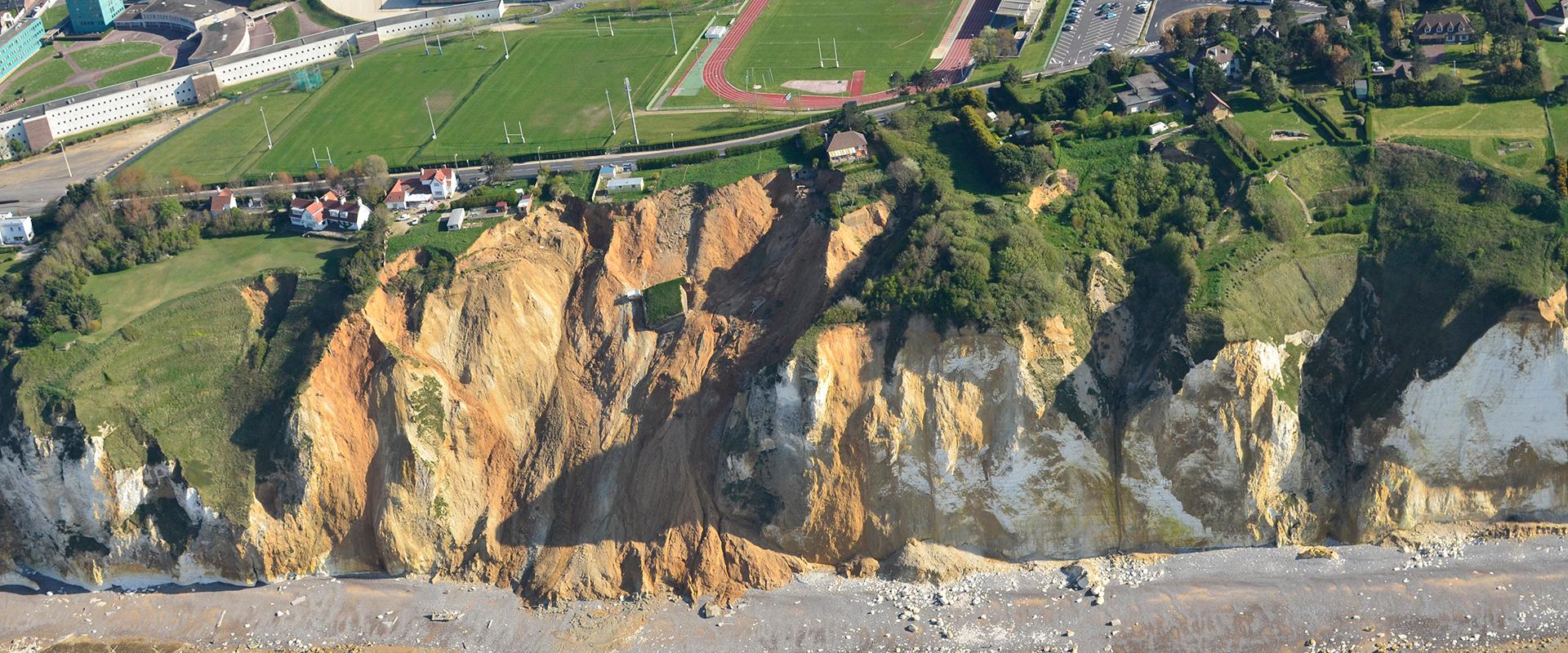
Current global systemic change exposes human societies to an unprecedented increase in risks and disasters, including landslides, floods, avalanches, climate extremes, wildfires, and earthquakes. This new nature of risk can also lead to severe technological disasters and major environmental threats, as revealed by recent polycrises, such as the Fukushima nuclear accident, Hurricane Katrina, or the wildfires in California.
Objectives
In this context, the Risks Research Program known as IRiMa – Integrated Risks Management for more resilient societies in the global systemic change era – seeks to understand the natural and social processes generating environmental and technological risks, with the goal of contributing to the development of an ambitious national strategy for risk and disaster management.
The program aims to:
- Bring together and integrate knowledge produced by various research communities, particularly in geosciences, engineering, digital sciences, and the humanities and social sciences (HSS), which are deeply engaged in risk-related issues, but often work in silos without direct interaction with society
- Generate knowledge on types of hazards, and the overlap and entanglement of different risks within the same territory
- Analyze the logics that structure risk management
- Develop innovative tools to better detect, understand, quantify, anticipate, and manage risks and disasters in all their complexity (extreme events, polycrises, cascading effects, multi-scale dynamics, and human and socio-economic challenges, etc.)
- Formalize a new science of risks to help develop a new strategy for risk and disaster management, and to accelerate the transition toward a society capable of facing a wide range of threats – whether hydro-climatic, seismic, technological, health-related, or combined – and of adapting and becoming more resilient.
The program will involve implementing a series of research and expert initiatives, covering the various dimensions of risk analysis and governance: identification, monitoring, assessment, preparedness, crisis management, post-disaster response, remediation, and prevention.
Beyond the expected scientific advances and innovations, the IRiMa Risks Research Program is designed to strengthen the organization of research capacities at the national level.
Six research pillars and eight targeted projects
The IRiMa Risks Research Program is structured around six major scientific pillars :
- Pillars 1 and 2 are dedicated to cross-cutting methodological challenges: they build the methodological foundations of conceptual frameworks and operational tools that encompass all possible pathways from data to decision-making, with context-dependent complexity and adaptability, making them particularly relevant for decision-makers.
- Pillars 3 to 5 focus on the specific challenges of risk-prone regions (mountains, coastlines, overseas territories, and industrial-urban areas), to study how different risks overlap in certain territories, sometimes leading to cascading effects.
- Pillar 6 focuses on development of the required digital platforms, with particular emphasis on interoperability.
It includes eight targeted research projects.
Three main categories of action
The IRiMa Risks Research Program is organized around:
- Coordination actions, whether scientific networking, or organization of assemblies and workshops
- Flagship projects to structure and strengthen five major research clusters: (coastal risks, mountain risks, NaTech risk, overseas risks, and a humanities and social sciences cluster), and to support research infrastructures and training initiatives, and international development
- Open projects to build the skills and infrastructure needed to strengthen the community in the long term, at both the national and European levels. These projects will be selected through a dedicated call for proposals.
Partners
The program is built around a national consortium bringing together major universities and national reference organizations active in the field of natural, technological, and environmental risks.
The IRiMa Risks Research Program includes 13 main partners:
- The three co-lead institutions: BRGM, CNRS, and UGA.
- INRAE, IPGP, INERIS, ASNR, IRD, Université de Bordeaux, Université Côte d’Azur, La Rochelle Université, ENS de Lyon, and Grenoble INP.
A research program within the France 2030 plan
The IRiMa Risks Research Program is one of the exploratory Priority Research and Equipment Programs (PEPRs) funded under the France 2030 plan. These programs aim to build or consolidate French leadership in emerging scientific fields of national and European interest. The goal is to explore scientific domains with potentially wide-ranging benefits.
On July 18, 2022, the French Ministry of Higher Education and Research (MESR) and the General Secretariat for Investment (SGPI) announced the selection of the IRiMa Risks Research Program by the French National Research Agency (ANR).