




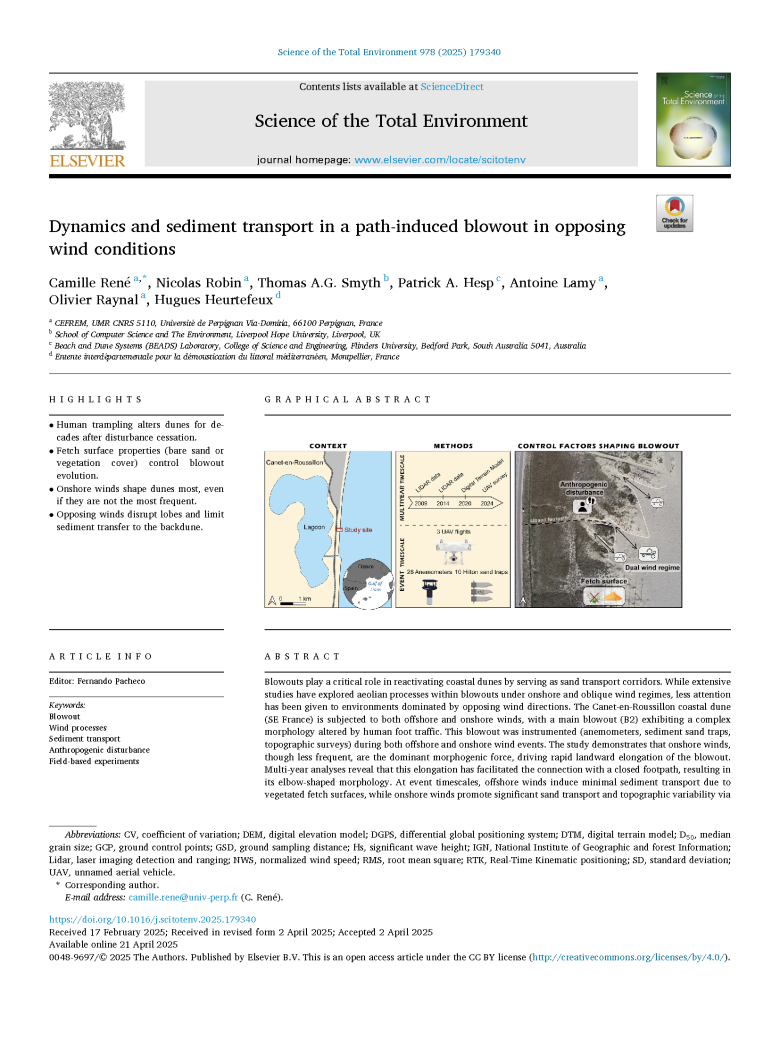
Blowouts play a critical role in reactivating coastal dunes by serving as sand transport corridors. While extensive studies have explored aeolian processes within blowouts under onshore and oblique wind regimes, less attention has been given to environments dominated by opposing wind directions.
The Canet-en-Roussillon coastal dune (SE France) is subjected to both offshore and onshore winds, with a main blowout (B2) exhibiting a complex morphology altered by human foot traffic. This blowout was instrumented (anemometers, sediment sand traps, topographic surveys) during both offshore and onshore wind events. The study demonstrates that onshore winds, though less frequent, are the dominant morphogenic force, driving rapid landward elongation of the blowout. Multi-year analyses reveal that this elongation has facilitated the connection with a closed footpath, resulting in its elbow-shaped morphology.
At event timescales, offshore winds induce minimal sediment transport due to vegetated fetch surfaces, while onshore winds promote significant sand transport and topographic variability via a bare sand fetch. Sand availability emerges as a critical factor modulating blowout evolution. The dual wind regime interacts with anthropogenic disturbances, sustaining the current morphology. Offshore winds transport sediment seaward, while the bifurcation of onshore winds by the footpath creates an internal accumulation zone, inhibiting depositional lobe formation and further elongation.
These findings challenge the traditional understanding of blowouts as unidirectional sand transport corridors in dual wind environments and highlight the role of anthropogenic influences on their morphology. Further research is needed to determine whether these mechanisms are consistent across larger blowouts with higher sand volumes.