

The program brings together a range of research projects on coastal, mountain, overseas and highly urbanised area risks, whose work notably aims to develop tools to assess and quantify these risks.
The Digital Platforms project seeks to interconnect these different tools. It aims to serve as a single entry point for the digital resources of program (data, tools, processing) and to design a platform to execute the risk scenarios defined within the projects.
The platform will be accessible to various actors (scientists, developers, trainers, etc.) and will rely on existing and new software solutions, described below, which will be connected to an internal and external data catalogue linked to the program.
The project is structured into four work packages:
- Infrastructure, dedicated to the study of required functionalities and data access, the deployment of infrastructures, and interface development;
- Functional building blocks, focused on software solution development;
- Case studies, aimed at collecting project needs for multi-risk scenarios, developing the required software interfaces, making tools and functionalities accessible within the platform, and implementing scenarios;
- Dissemination – educational platform, dedicated to analysing existing risk education schemes and identifying the needs and expectations of different audiences, with a view to providing dedicated resources on the developed platform.
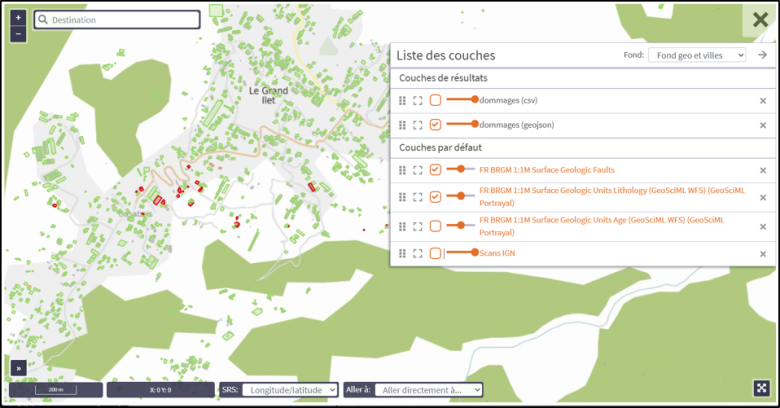
Calcul de dommages pour les séismes, les mouvements de terrain
© BRGM
From Multi-Risk Assessment to AI-Based Automatic Hazard and Risk Mapping: Focus on the Functional Building Blocks
The platform will rely on four solutions:
Vigirisk: a functional tool for multi-risk assessment
Developed by BRGM, this tool currently includes 19 processing chains covering various risks (gravitational, seismic, volcanic, tsunami, coastal, etc.) and workflows across the entire risk chain, from hazard assessment to modelling and simulation, and impact estimation on exposed assets. It is a computational platform that takes parameters as input (water depth, macroseismic intensity, number of buildings, etc.) and produces maps or tables as output, which are then post-processed.
The tool integrates different approaches (empirical, semi-empirical, analytical methods, fragility curves, damage probability matrices (DPM), meta-models) and enables, for example, damage estimation for earthquakes or landslides.
Within the program, the aim will be to evolve the architecture of Vigirisk to scale up its use, reduce computation times, improve usability of the processing chains, and meet the needs identified by project case studies through the integration of scientific codes and the development of new functionalities.
Mira+ Components Developed by INERIS for the Assessment and/or Management of Technological Risks
These components provide a range of functionalities:
- Automatic collection of data of various types over a given area (natural, urban and industrial environments, infrastructure, networks, territorial conditions, natural resources);
- Creation of bow-tie diagrams centred on a feared event, making it possible to represent causes, potential consequences, safety barriers and risk control measures;
- Calculation of the effects of hazardous phenomena such as the thermal effects of hydrocarbon pool fires, or the characteristics and thermal effects of fireballs;
- Characterisation of domino effects within complex industrial systems, including multi-site configurations;
- Intelligent document management: this functionality enables users to ask questions about the content of documents indexed in a database (but not exposed on the internet), using an open-source language model.
These functionalities, currently implemented within various applications, will need to be transformed into application programming interfaces (APIs) and then into web services in order to be accessible via the platform developed under this project.
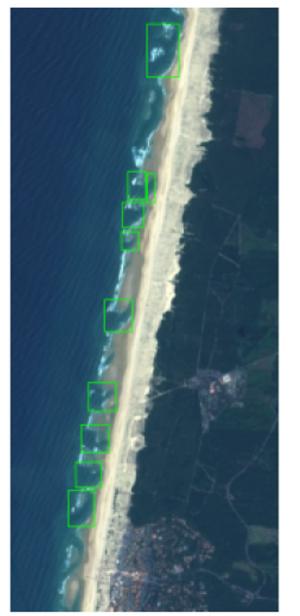
Etude pilote – Sentinel2
@EPOC, 2024
Intelligent Mapping
This is a software component to be developed, with the following objectives:
- Develop artificial intelligence (AI) algorithms to automatically identify and map, in Earth observation images, objects contributing to or resulting from natural and anthropogenic disasters. Examples include detecting and tracking rip currents (baïnes), which are a cause of drownings in coastal areas, or mapping floods and destruction caused by storms such as Storm Alex in 2020, which is valuable for locating survivors and estimating damage. In collaboration with the targeted Overseas Risks project of PEPR Risques, work will be carried out to map the combined factors leading to extreme flooding in New Caledonia;
- Provide automatic mapping of any region affected, or likely to be affected, by a natural or anthropogenic disaster (floods, earthquakes, wildfires, etc.) and of any catastrophic event causing damage to infrastructure or the environment;
- Operate at different spatial and temporal scales thanks to available data (near real-time in the event of a disaster, and monitoring of changes through image time series);
- Provide access to data, algorithms and results via the program's platform.
Web 2.0
Finally, a “Web 2.0” component will be specifically developed within this project to leverage data from citizen-generated measurements. Citizen measurements (videos, texts, digital social networks) offer significant potential to “inform” crisis situations.
The challenge will be to build a pre-operational platform dedicated to collecting and exploiting these data during natural, industrial or NaTech disasters in order to:
- Understand the physical and social phenomena at play during crises, particularly in poorly “instrumented” territories, such as damage to civil engineering infrastructure and debris during earthquakes, storms, floods or debris flows; flow velocities and discharge rates in urban areas during major floods; or population movements;
- Assess their potential contribution to high spatial- and temporal-resolution impact models for early warning, operational forecasting or crisis management.
This will involve mapping existing initiatives, identifying two case studies based on a mapping of past industrial, natural and NaTech crises already studied and for which citizen data and products are available; harvesting and exploiting data from the case studies; defining the desired level of interoperability with national research infrastructures and existing national platforms (vigirisk, suricat-nat.org, visov.org, etc.); and setting up a pre-operational platform.
Beyond the development of software components, work will be carried out within work package 3, in conjunction with work package 1, to develop the software interfaces required for the proper execution of case studies, make tools and functionalities accessible within the platform, and ultimately implement and run scenarios on the platform.
Finally, within a fourth work package, the team will design the modalities and formats for disseminating various resources via the program's platform, intended for educational activities and for different non-specialist audiences seeking scientific information on the risks addressed within the PEPR. The objective is to strengthen risk education activities by deploying the necessary tools and delivering content incrementally throughout the project via the program's platform. This work is structured around three main actions:
- Analysis of existing educational schemes and identification of target audiences;
- Development of a generic educational toolkit adaptable to different pilot sites;
- Design of a user interface for educational resources.
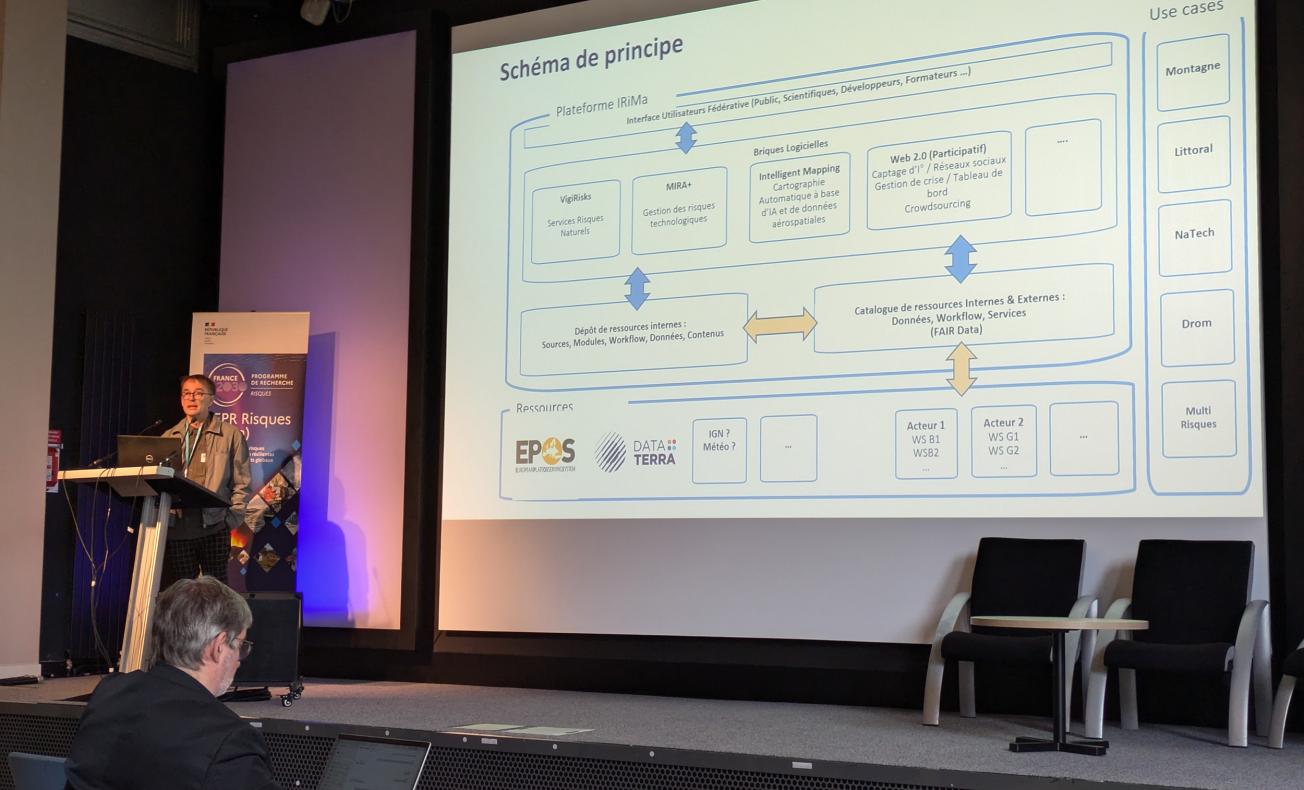
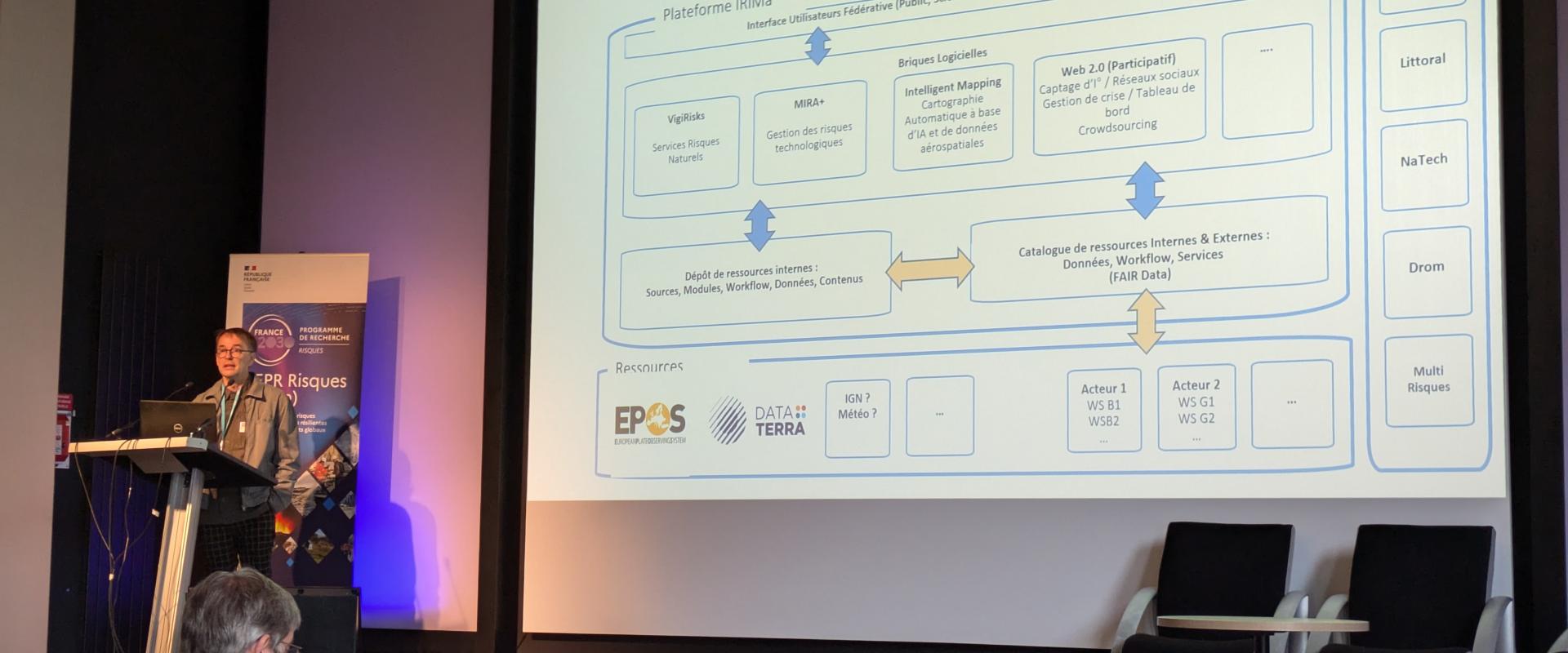
Réunion de lancement du projet Plateformes numériques
© PEPR Risques
The kick-off meeting provided an opportunity to bring together project members, targeted PEPR Risques projects, and the ANR, and to encourage exchanges on the initial work to be launched.
Learn more