

An extreme event as a scientific opportunity
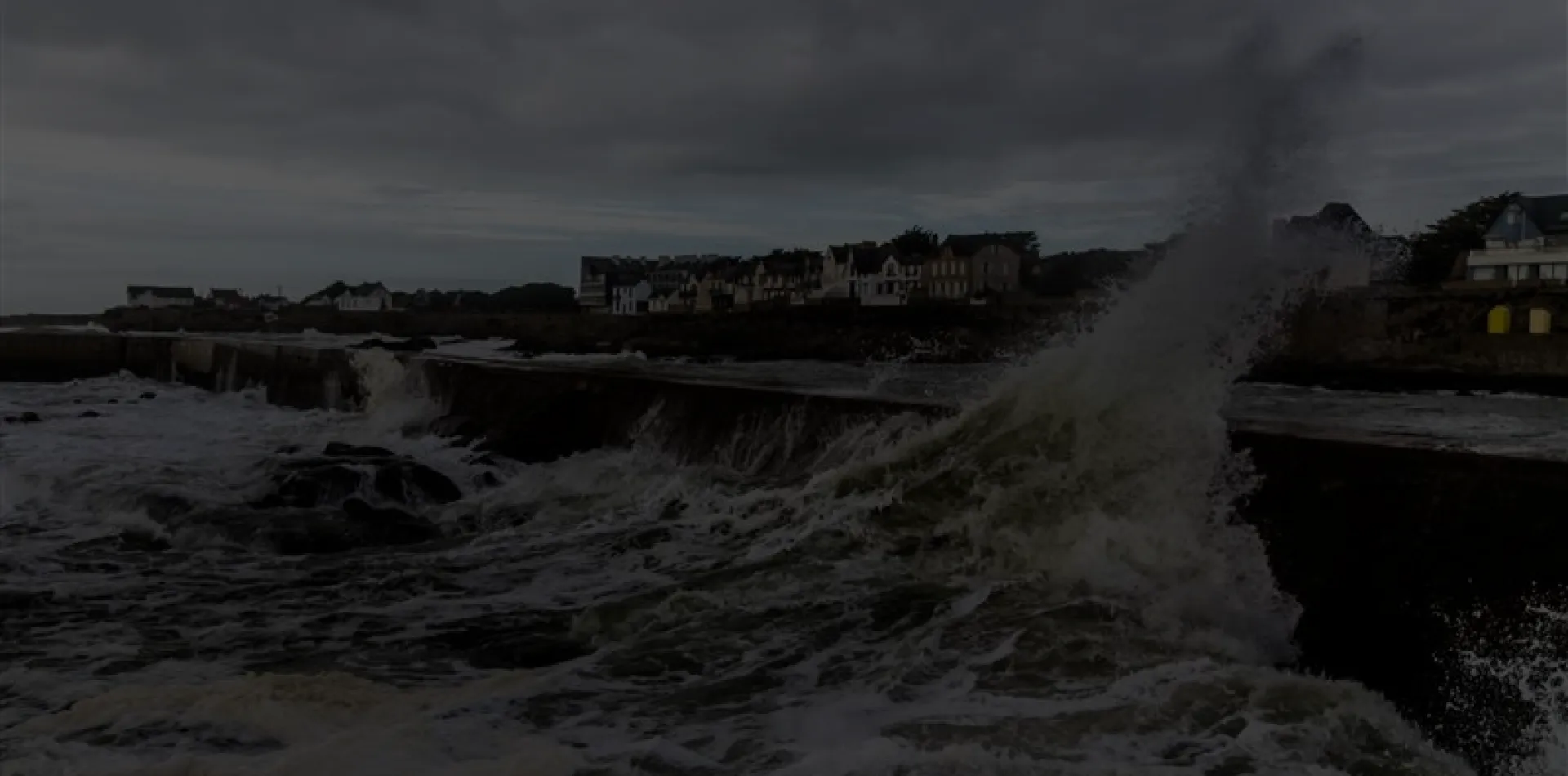
Under ordinary conditions, the morphological evolution of dunes is slow, but under the strain of a storm, everything accelerates: sand shifts in massive quantities and the morphology of the dune ridge can change significantly within a matter of hours. These are precisely the conditions the scientists had been waiting for in order to collect the data needed for their work.
The objective of this work package, dedicated to improving knowledge of extreme events, is clear: to build an original database on dune erosion during extreme events, so as to feed and calibrate numerical models of coastal morphodynamics. But this, of course, requires the storm to show up.
Since autumn 2025, the consortium — involving the University of Perpignan (CEFREM), BRGM, the University of Bordeaux (EPOC) and Delft University, alongside National forest service (ONF) field officers — had been keeping a close meteorological watch. In winter, one or two storm episodes of sufficient intensity may occur, or may not occur at all. When the forecast models announced the passage of Goretti at the beginning of January, the decision was made immediately.
Three profiles, three management approaches
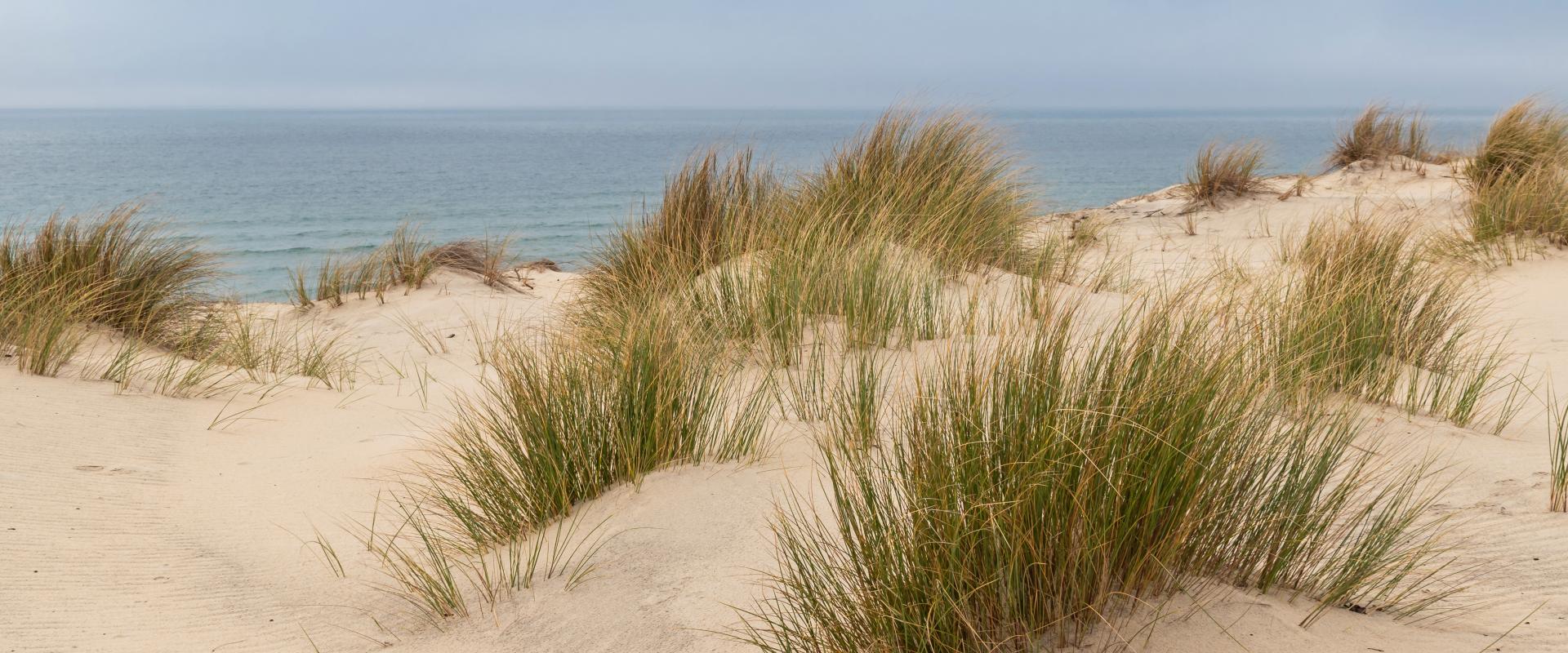
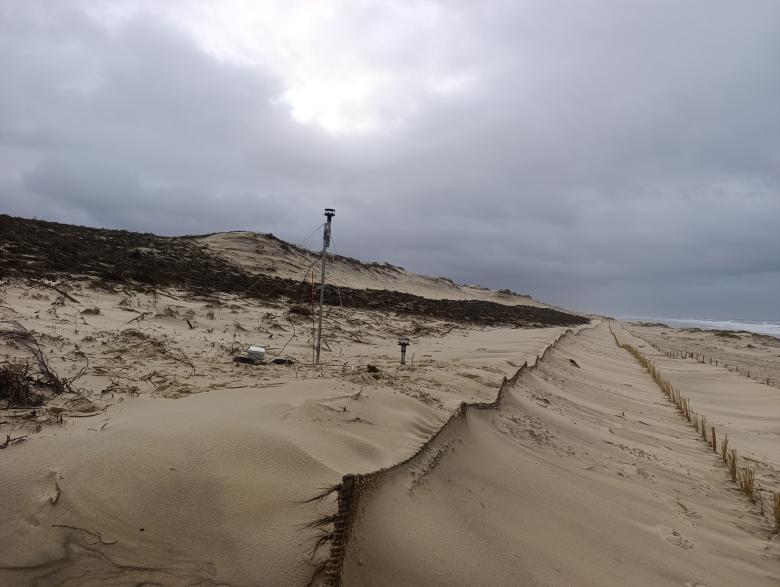
The site chosen for this campaign, named "La Limite", on the boundary between the municipalities of La Teste-de-Buch and Biscarrosse, is no coincidence. It is one of the working sites of the DUNES Project (a Regional research project), the setting for several dune management experiments conducted by the ONF since 2015. Across three distinct but nearby profiles, known as "transects", radically different management approaches are in operation.
- The first transect corresponds to an older management regime, whose effects have shaped a profile close to its natural state.
- The other two, more recent and managed by the ONF, experiment with different modalities of dune stabilisation (broom cover) in two configurations:
- ground-level cover aimed at stimulating the emergence and development of a foredune ;
- a cover of the entire front face of the dune.
This diversity of situations makes the site a full-scale laboratory for testing the influence of management method on dune response to a storm.
It is in this context that the various academic teams, accompanied by ONF officers, deployed a large-scale instrumentation setup.
An exceptionally large instrument array at the international scale
Across the three transects, 34 anemometers and 17 aeolian transport stations were installed simultaneously. Pressure sensors were also deployed on the beach to measure water level and wave height. Topographic surveys were carried out daily to quantify the morphological changes at the site. A setup that goes well beyond what the international scientific literature typically records.
What is generally done is a single transect perpendicular to the dune, with 4 or 5 measurement stations. Here we had 3 transects, with 5 or 6 stations on each transect, all running simultaneously. This is very original compared to the databases that exist in the literature.
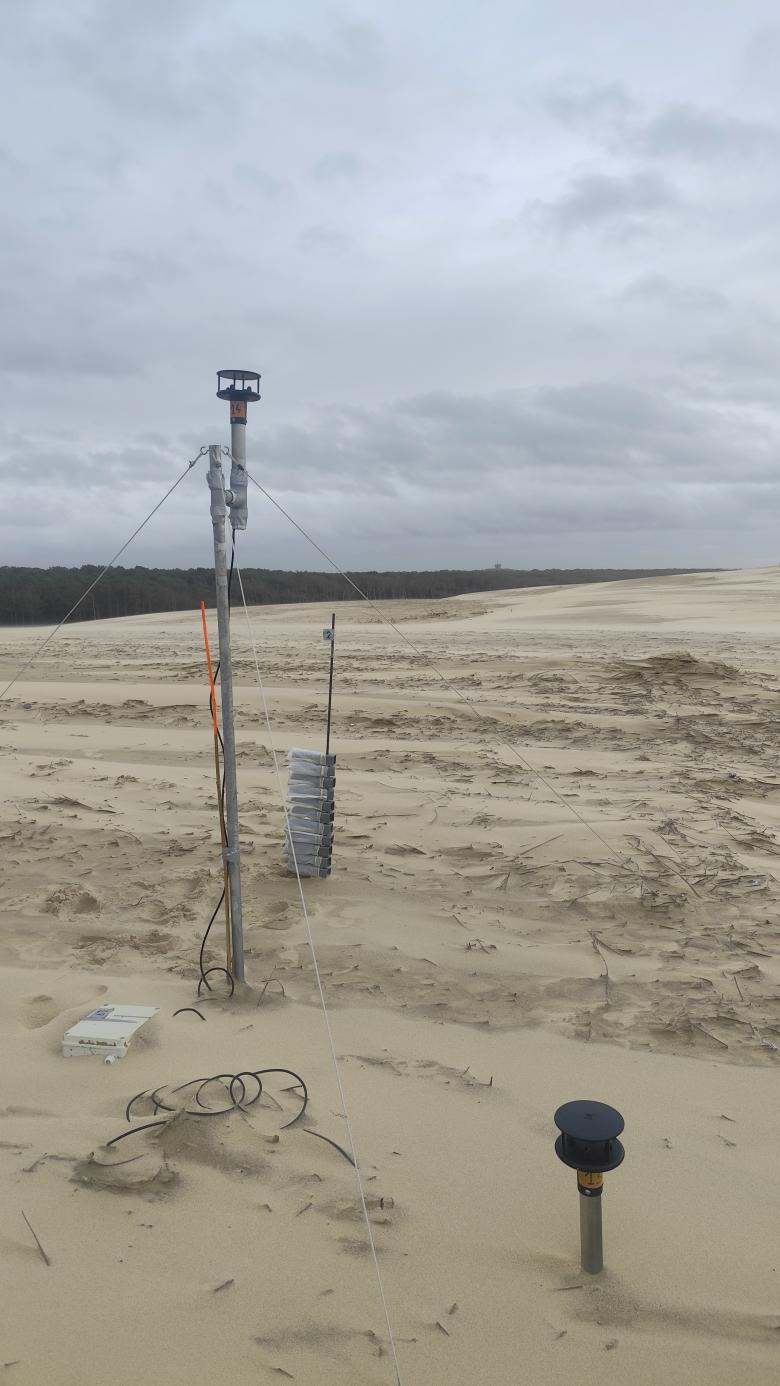
The aeolian transport measurement stations operate on an ingenious principle: sediment traps, facing into the wind, are stacked vertically along a stake. Each one is fitted with an opening and a soft receptacle at the back that captures sand grains transported by the wind. Deployed over the first 60 centimetres above the ground — where the bulk of aeolian transport is concentrated — they allow, once weighed and compiled, for the calculation of a precise sediment flux.
Under ordinary conditions, these traps are left in place for 10 to 15 minutes. During Goretti, the power of the storm imposed a very different rhythm of 5 minutes, to prevent the traps from becoming obstructed in the face of an extremely high sediment transport.
Continuous measurements, including overnight
The night of 8 to 9 January was the heart of the campaign. It is during this period that the most valuable data was captured, recorded at the height of the storm. Seven measurement sequences, known as "runs", were organised successively and simultaneously across the three transects.
A scientific operation that demands a certain physical endurance. After each 5-minute run in winds exceeding 100 km/h, the teams brought the sediment traps to shelter behind the dune. There, painstaking work began: emptying each trap, weighing, carefully labelling each bag. "It takes a good hour, even with 15 people," summarises Camille René (CEFREM). Then back out into the field for another run. And so on, until dawn.
Around fifteen people took turns without interruption to maintain this pace. Far from being a minor detail, this human organisation is an essential component of the campaign: ensuring that the instruments do not topple over, maintaining continuous monitoring, and guaranteeing each person a rest period without interrupting the data collection.
From data collection to decision support for management
Once data collection was complete, the teams entered a second phase: analysing the database that had been built. Two broad orientations guide this work.
The first is analytical in nature: understanding how wind speeds and directions change across the dune relief depending on the management practices in place, how these parameters influence sediment flux, and how the dune morphology evolved differently from one transect to another. A "naturalistic" approach.
The second is numerical in nature: the database will be used to calibrate models of dune morphodynamics. For a numerical model, however sophisticated, can only produce reliable results if it has been calibrated with a sufficient quantity of high-quality data.
These calibrated models will then be used to simulate different management configurations — revegetation, dune reprofiling, installation of brushwood fences — in order to guide the decisions of managers and the sizing of these solutions. This work, which will be carried out under the DUNES project, is intended to benefit the operational partners involved in coastal management: the ONF, inter-municipal communities, deconcentrated State services, and coastal municipalities.
The Aquitaine coastline is very representative of everything that happens along the north-western European Atlantic coast. What emerges from this in terms of best practices will filter through to all managers who are responsible for a stretch of coastline.
A scientific niche with global stakes
Research on aeolian dune processes under extreme conditions remains a niche field. Few teams in the world have access to such a volume of instruments at exposed sites. This is precisely why the database built during this campaign holds particular scientific value at the international scale.
The results will be communicated to the scientific community through publications and national and international conferences, but also directly to managers, starting with the ONF.
This campaign marks the end of the data collection phase of work package 2, one of whose central objectives was precisely to obtain data during an extreme event. Objective achieved: all instruments functioned, the data is currently being post-processed, and the database is under construction.
Everything worked. The objectives in terms of data recording have been met. We will now move into a second phase: the analysis of this data.