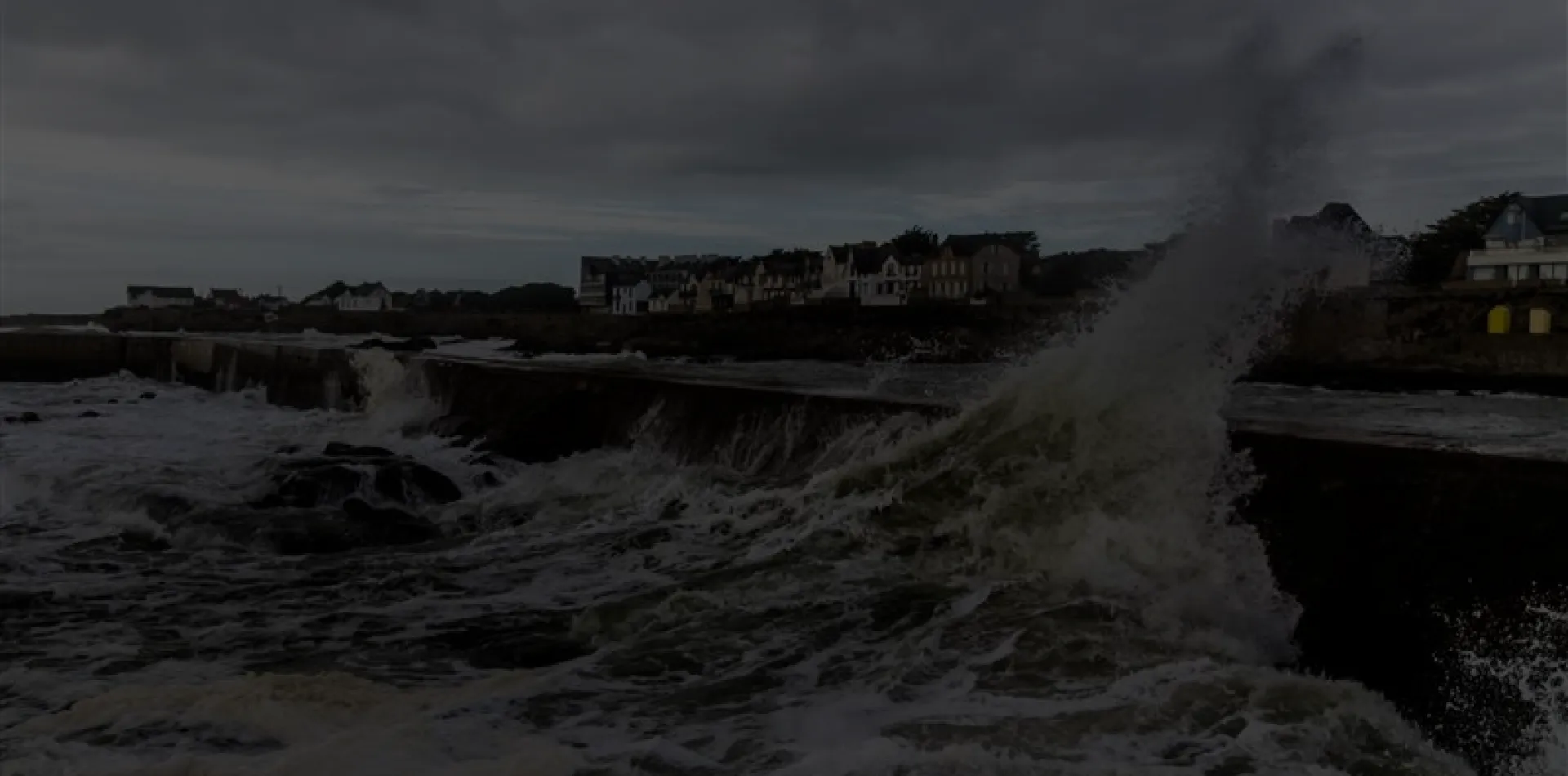

Attractive yet vulnerable territories, coastal areas are experiencing rapid changes in social practices, with conflicts of use, and are facing hazards of increasing magnitude. In particular, they are subject to a global phenomenon of erosion, as well as increasingly frequent coastal flooding. Improved knowledge of coastal hazards and risks is therefore necessary to prepare local societies for the challenges associated with global change.
However, several bottlenecks currently exist: insufficient knowledge and imperfect modelling of social and physical processes and impacts hinder the prediction and mitigation of erosion and flooding risks, and the relationships between intermediate and local scales remain poorly understood.
In this context, the targeted IRICOT project, coordinated by Aldo Sottolichio (University of Bordeaux) and Eric David (BRGM) within the Risques (IRiMa) research programme, aims to address several objectives:
- Better understand and quantify socio-historical processes
- Improve understanding of coastal hydrosedimentary processes at the origin of erosion and flooding hazards
- Improve methods for scaling down from the regional to the local level, where exposed assets are located
- Integrate these advances into refined risk and crisis management assessments
- Understand, formalise and model the changing nature of multiple and cascading risks
- Establish projections and risk mapping that take these evolutions into account
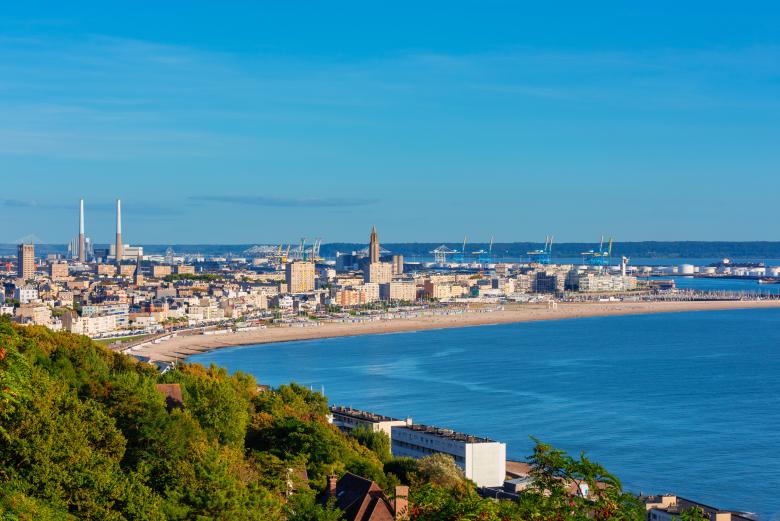
Le Havre, Normandie, France
© Adobe Stock
From the Analysis of Historical Coastal Hazard Management to the Transformative Potential of Risk Governance
The project is structured into several work packages presented during the kick-off meeting.
1. Socio-historical analysis of coastal risk management and its impacts
An initial line of work aims to produce operational knowledge for adaptation, focusing on the evolution of natural hazards and anthropogenic effects, territories in their historical context, their risk culture, and their physico-socio-economic evolution, while taking into account local population knowledge.
The team will focus on:
- Studying the role of past anthropogenic developments in the propagation of hazards and their impacts today, as well as historical risk management practices
- Co-constructing adaptation pathways more firmly anchored in territories
- Improving knowledge of marine flooding hazards through numerical modelling of overtopping during extreme events in estuarine areas (Le Havre area), and disseminating results via an augmented virtual reality tool
This work will be carried out in coordination with other PEPR projects (Risques NaTech, Digital Platforms, IRIMONT) and other projects and communities.
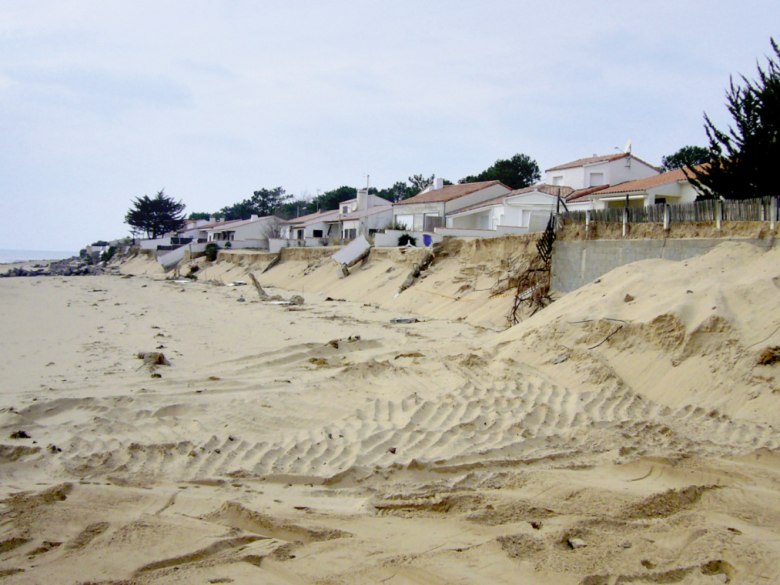
Dégâts sur les maisons causés par l’érosion de la dune à la Tranche-sur-Mer, suite à la tempête Xynthia (Vendée, 2010).
© BRGM - Rodrigo Pedreros
2. Impacts of Major Events
A second work package focuses on erosion during storm events. The impact of extreme events on the long-term dynamics of erosion remains poorly understood, yet improved knowledge is all the more necessary given that erosion affects other phenomena such as coastal flooding or the triggering of instabilities.
The objective of this work is to quantify what happens during storm events, with a focus on:
- Erosion of sandy beaches during high-energy events: hydrodynamic transport driven by waves and by wind;
- The role of storm waves in destabilising cliff sections.
Three major actions are planned: measuring aeolian processes along the beach–dune profile during storms; studying the fate of sediments eroded from beaches during storm events; and examining the role of wave impacts in the destabilisation of cliff sections through data acquisition, modelling, and the integration of this knowledge into a forecasting model.
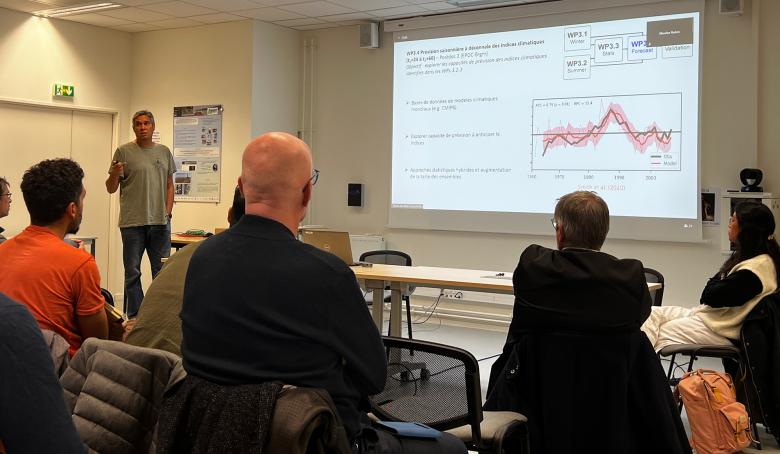
Présentation du workpackage 3 lors de la réunion de lancement du projet IRICOT
© PEPR Risques
3. Seasonal to Decadal Forecasting of Coastal Risks
A third line of work aims to better understand, statistically model and improve forecasts of a range of coastal hazards and indicators. It covers different types of coastlines, at the scale of the Atlantic and Mediterranean coastal façades in metropolitan France.
A very strong seasonal and interannual variability in hydroclimatic forcing is observed. Over the next 30 to 40 years, the variance of shoreline change signals and their uncertainties will be largely controlled by this seasonal and interannual variability, hence the importance of improving forecasting at these timescales.
This work will aim to:
- Identify and diagnose statistical relationships between winter climate indices and indicators representative of the coastal system, and between summer climate indices and indicators representative of the coastal system;
- Develop and deliver statistical tools for prediction and causality analysis between variables;
- Explore the forecasting capabilities of the identified climate indices;
- Develop a climate services demonstrator focused on seasonal to decadal forecasting of coastal risks.
4. Adaptation Solutions to Multiple Coastal Risks
A final interdisciplinary work package, with a strong component in the social sciences and humanities (SSH), focuses on adaptation solutions, which requires addressing three main bottlenecks:
- Moving beyond a sectoral approach to risks;
- Improving knowledge of the consequences of hazards and risks on territories, including impacts on well-being, inequality distribution, territorial reconfigurations, and insurance mechanisms;
- Examining the transformative potential of risk governance.
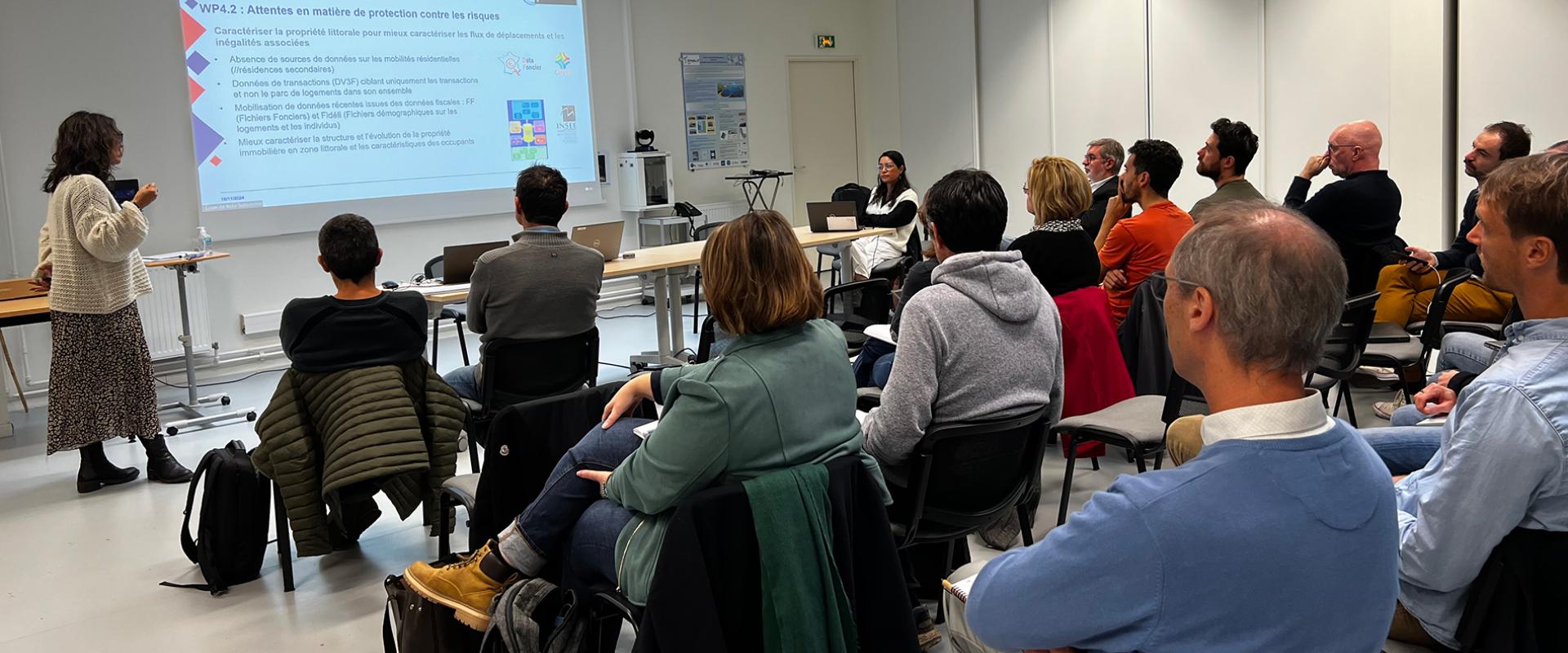
The kick-off meeting held on 18 November at the University of Bordeaux provided an opportunity to bring together project members and foster exchanges on the various work packages in order to successfully launch the research activities.
IRICOT brings together specialists in coastal dynamics from environmental sciences (physics, geology, fluid mechanics) and from the social sciences and humanities (history, economics, geography).
It brings together 14 key national actors in coastal risk research: University of Bordeaux (coordinating institution), University of La Rochelle, University of Pau and Pays de l’Adour, University of Poitiers, University of Perpignan, University of Caen, University of Rouen, University of Western Brittany, INRAE, CNRS, BRGM, IRSN, Météo-France and CEREMA.
Learn more: