
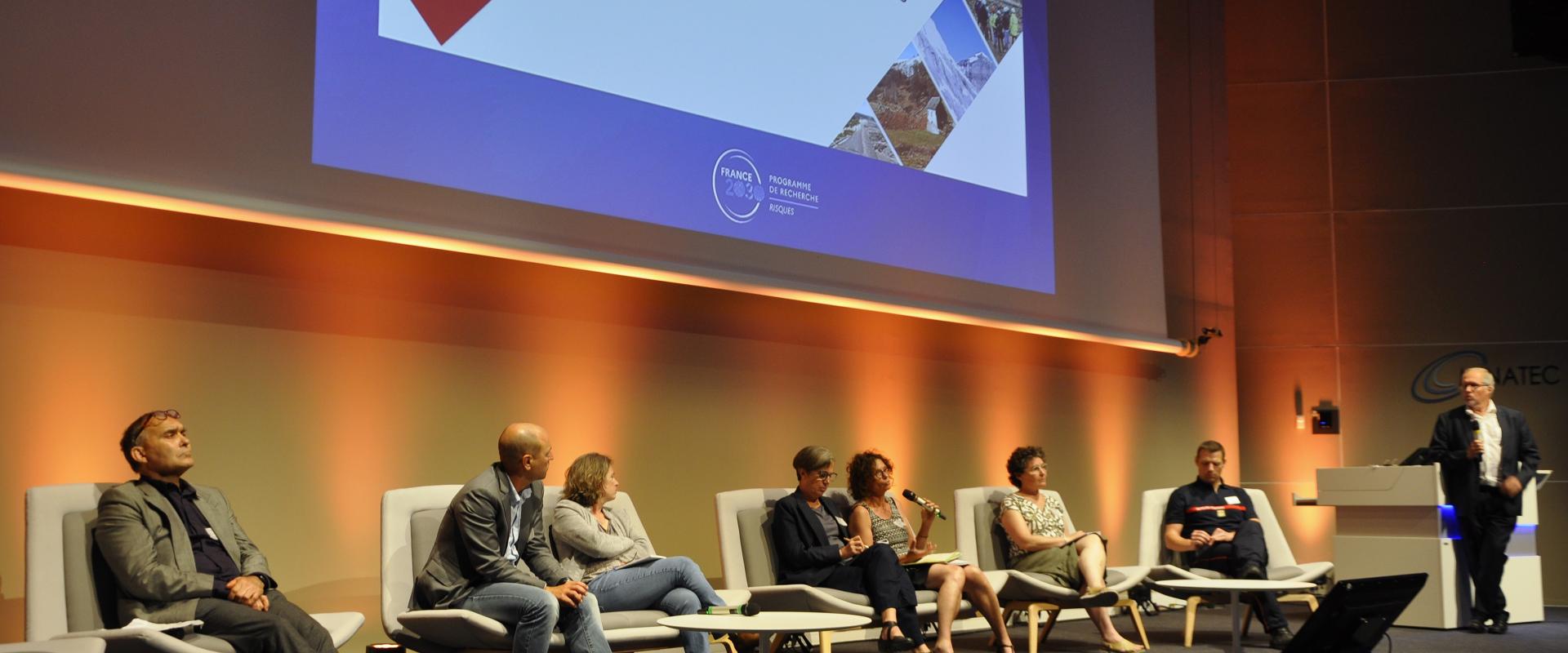
Michel Jaboyedoff, from the University of Lausanne gave a conference on challenges related to gravitational movement risks and numerous representatives from the academic, associative, political worlds and civil security were able to present their work and exchange on common themes during roundtables. Finally, 5 programs (PEPR) came together on this day to discuss together, alongside the Risks program, their collaboration opportunities.

Young scientists' presentations
Thesis topics presented within the mountain risks project (IRIMONT)
Lucie Armand: "early warning system for shallow landslides at regional scale"
Lucie Armand will conduct this thesis project to understand how landslides induced by an extreme event influence characterization of landslide triggering conditions.
Her work will be organized in two axes:
- Improve knowledge of triggering conditions, to identify and prioritize most relevant characteristics and combine all these factors to understand more precisely landslide triggering conditions;
- Take into account phenomenon propagation to analyze probability of reaching areas at stake.
Direction: Guillaume Chambon (INRAE/IGE).
Co-supervision: Séverine Bernardie; Olivier Cerdan (BRGM).
Juliette Bazin: "Perception and collective management of glacial and periglacial origin risks (ROGP) in the Alps"
This multidisciplinary thesis in ergonomics and geosciences, conducted by Juliette Bazin, aims to understand management of risks linked to ROGPs under climate change effects, and relationships between territorial actors to promote co-construction of risk management and prevention actions.
This work will be conducted both at global and historical scale and from a case study:
- Event database:
- Through historical rereading of events: evaluate their frequency and distribution & understand how ROGP risk management was built according to Alpine arc countries and through the risk perception prism current at the time of the event.
- La Bérarde case study after the June 2024 torrential flood:
- Via a series of interviews with experts working on feedback and authorities: understand feedback construction and use of risk management pillars during and after the event and evaluate crisis impacts on working conditions and health.
Co-direction: Sandrine Caroly (UGA); Ludovic Ravanel (EDYTEM/CNRS/USMB).
Alix Bisquert: "Combining historical and paleo-environmental archives to optimize reconstruction of past activity of natural hazards generating mountain risks over the period 1800-2025"
The thesis conducted by Alix Bisquert will combine data from different sources, one historical, the other paleo-environmental. The major challenge will be characterizing used sources, evaluating their contributions, limits, spatial and temporal resolutions.
All this allowing reliable use of this data to develop a generic methodology that would allow combining historical and paleo-environmental data, resulting in a precise chronology of a hazard.
This objective will require compilation of historical and dendro-geomorphological data concerning avalanches, since 1800 (avalanches representing a diversified and good quality archival source).
This work will focus on two targeted and already well-documented areas: the Vosges and Queyras massifs over the period 1800-2025.
Co-direction: Nicolas Eckert (INRAE/UGA); Florie Giacona (UGA/INRAE/CNRS); Christophe Corona (UGA/USMB/CNRS).
Ronald Concha: "Spatio-temporal distribution of extreme rock-ice paleo-avalanches in the cordillera blanca, Peru"
This thesis work conducted by Ronald Concha will study spatiotemporal dynamics of large-scale gravitational instabilities in the Cordillera Blanca, Peru.
It will seek to understand what relationships exist between frequency, magnitude, topo-climatic conditions, and geometric characteristics of these instabilities.
Already, comparison with local paleoclimatic data suggests concomitance between extreme gravitational events and late Pleistocene/Holocene climatic fluctuations.
Other paleo-gravitational events will be mapped and targeted for dating in adjacent valleys, to broaden the database and achieve finer understanding of this phenomenon.
Co-direction: Julien Carcaillet (CNRS); Swann Zerathe (IRD); Benjamin Lehmann (CNRS).
Chloé Gergely: "Modeling instability phenomena in mixed rock and ice massifs and granular flows linked to permafrost thaw in high mountains"
Facing increasing size and frequency of rockfalls, Chloé Gergely's thesis focuses on developing numerical models that will aim to model instabilities linked to permafrost warming and rockfalls with fragmentation.
To realize these models, the conducted work will be based on methods from non-smooth dynamics* and cohesive zone models. This will reduce these issues to a format that can be easily solved today.
Work on numerical methods will also be conducted, to ensure optimal design allowing models to be less numerically expensive, more sustainable, while maintaining optimal modeling quality.
Co-direction: Vincent Acary (Inria); Franck Bourrier (INRAE).
*Theoretical and numerical framework adapted to modeling mechanical systems with discontinuities, such as shocks, dry friction, unilateral contacts, as well as plasticity and rupture.
Maud Megret: "Reconstruction of spatio-temporal evolution of glacier fronts by stochastic simulation"
Moraines, sedimentary accumulations in front of glaciers, through their dating and positions, inform us about their trajectories and thus allow understanding their dynamics.
Maud Megret's work conducted during this thesis will consist of implementing statistical methods, particularly based on record value theory, to reconstruct past glacier trajectories.
Co-direction: Philippe Naveau (CNRS); Nicolas Eckert (INRAE/UGA); Mike Pereira (École des Mines Paris - PSL); Vincent Jomelli (CNRS).
Thesis topics presented within the NaTech risks project
Claire Jaffrézic: "Learning from feedback: methods and issues for optimized warning process management facing a crisis situation"
This thesis project conducted by Claire Jaffrézic aims to research how to adapt the warning process facing NaTech risk, based on lessons learned from past feedback.
She will mobilize different methods, particularly:
- Spatial analysis to have a synoptic view of NaTech risk;
- Semi-directive interviews to analyze actors' roles, their interactions, decision and warning transmission chains;
- Feedback analysis to capitalize on past experience to improve future responses in warning matters.
Co-direction: Johnny Douvinet (Avignon University); Karine Weiss (University of Nîmes); Elsa Gisquet (ASNR); Eric Daudé (CNRS/University of Rouen).
Victoria Mowbray: "Combining updated structural and geophysical data into seismic source models for psha of se (south-east) france"
Victoria Mowbray works on probabilistic seismic hazard assessment (PSHA). This thesis work focuses on southeastern France, characterized by low to moderate seismicity, slow active deformation, and complex tectonic structure. This work relies on developing two models:
- A fault model for PSHA from a selection of faults from the potentially active fault database (BDFA), with estimation of horizontal geodetic slip rates;
- A seismotectonic zonation model based on structural geology, seismicity, and crustal deformation.
Co-direction: Céline Beauval (IRD); Christian Sue (UGA). Co-supervision: Anne Lemoine (BRGM); Margot Mathey (IRSN); Stéphane Baize (ASNR).
Thesis topic presented within the Risks and Societies project (RISC)
Juliette Quénéa: "Climatization of habitus by force. a comparative survey between france and spain"
This thesis project will study links between experience of extreme climatic events and ecological behaviors of French and Spanish people. Juliette Quénéa will analyze the socializing potential of extreme climatic events by exploring their differentiated effects on three key aspects:
- Consumption practices;
- Relationship to housing;
- Political behavior.
This work will be conducted via quantitative and qualitative survey with particular weight given to individuals' social position.
Co-direction: Benoit Giry (Sciences Po Rennes/CNRS); Philippe Coulangeon (CNRS).
Conference
This presentation was preceded, only a few days earlier, by the disaster affecting the village of Blatten in Switzerland, which tragically exemplifies the consequences of gravitational movement hazards in mountain environments. After presenting the event, supported by the most recent data from Swiss scientific institutions, Michel Jaboyedoff (University of Lausanne) recalled the conceptual framework used in the study of mass movements.
Indeed, when studying an instability, the development of conceptual models (mapping, environmental context, cross-sections, hydrogeology, etc.) constitutes the first essential step to quantify hazards and derive failure scenarios.
Drawing on numerous international studies, he presented several of the most significant current challenges, such as:
- methods for assessing failure or triggering hazards;
- differences between alarm systems and early warning systems, and the necessity of each;
- monitoring tools for gravitational movements;
- meteorological factors and criteria implemented in alert thresholds;
- mitigation measures for gravitational movements, notably nature-based solutions.
Despite the implementation of integrated risk management, he emphasized that uncertainties are an inherent part of risk management and can be beneficial, provided they are acknowledged and effectively used.
“Decisions must be grounded in arguments and based on the available facts as well as on the technical and scientific knowledge existing at the time they are made.”
— Michel Jaboyedoff
His presentation concluded with the identification of key research directions for the coming years:
- methodologies for establishing conceptual models;
- quality of inventories;
- number of monitored sites;
- snowmelt and precipitation;
- population tolerance (neuroscience studies and participatory approaches);
- etc.
Round table discussion – Risk cciences and climate change: the hydro-climatic challenge

This discussion, moderated by Gilles Grandjean (BRGM / co-director of the programme), focused on research challenges in the field of hydro-climatic risk sciences related to climate disruption.
Cyclonic phenomena such as Cyclone Shido, which affected Mayotte, and marine flooding in estuarine zones highlight the impact of urbanisation on the increase and management of risks. In addition, the study and application of traditional construction knowledge, as well as the growing interdisciplinarity in modelling climate extremes, shed light on new pathways for anticipation and post-disaster management.
These expert contributions opened discussions on shared challenges such as access to drinking water, the structuring of interdisciplinarity, engagement with local stakeholders, and raising awareness within the media sphere to facilitate the development and transfer of integrated and operational risk management.
Speakers list with replay and presentations in French:
- Bernard Guézo, expert in adaptation to global change, territorial engineering and resilience, member of AFPCNT, former lead of the Cerema Risk Programme (replay / presentation).
- Nicolas Eckert (INRAE), researcher in mountain risks, cryosphere and mountain climate, glaciers, co-coordinator of the Risk Institute (UGA) (replay / présentation).
- Aldo Sottolichio (University of Bordeaux), researcher in geosciences and coastal physics (replay / présentation).
- Philippe Garnier, architect and researcher at ENSAG (replay / présentation).
Replay complet
When demographic and urban growth shape risk anticipation and management
Bernard Guézo shared his feedback from experience, notably in Overseas Territories and Asia, highlighting the influence of urbanisation and demographic growth on risk management beyond the mere increase in exposed assets. For a given territory, it is relatively easy to imagine that the most appropriate behaviours in the face of natural hazards are transmitted across generations. However, in contexts of rapid demographic and urban growth, such as in Mayotte, this progression disrupts the usual pace of knowledge transmission and appropriate reflexes. Often underestimated, this evolution proves to be crucial in shaping risk culture and supporting populations during such events.
Demographic and urban growth weaken territories already exposed to natural hazards exacerbated by climate change. This is the case for the coastal territory of Semarang (Java, Indonesia), which is exposed to erosion, sea-level rise and intensified meteorological disturbances. This growth destabilises the sedimentary subsoil. Significant water withdrawals required for population and economic activities accentuate natural subsidence, thereby increasing marine and inland flooding. In Semarang, this impact is particularly striking, with subsidence of urbanised coastal areas reaching 12 to 14 cm per year—more than 1 metre over ten years—an evolution closely correlated with increased urbanisation.
Interdisciplinarity in support of modelling
Climate change profoundly affects risk-generating hazards, particularly return periods for which the assumption of stationarity is now obsolete. Nicolas Eckert nonetheless notes that the concurrent evolution of exposed assets and their environment renders risks highly non-stationary across all components, often with a dominant influence. Accounting for these evolutions and the growing complexities they generate (such as cascading effects) poses major challenges for research.
At a fundamental level, the challenge lies in developing a generic and integrative conceptual vision of risks to operationalise the concept of multi-risk, with a detailed understanding of the processes involved enabling extrapolation. This is where interdisciplinarity becomes central, notably through the use of historical studies that leverage archival analyses to develop essential projections combining long-term learning with future climatic and socio-environmental scenarios. New statistical artificial intelligence models are also mobilised, combined with established explicit statistical modelling. As learning models and remote sensing evolve, opportunities multiply to combine the strengths of different approaches.
The expected outcomes will be invaluable in enhancing understanding of the processes involved, linking global projections to local impacts, and better understanding the evolution of risks as a function of management strategies, thereby enabling evidence-based adaptation and more reliable decision support.
Climate warming and urbanisation: increased risks for biodiversity and infrastructure in estuarine areas
In a context of climate warming, Aldo Sottolichio warns of a worrying increase in the risk of flooding for human populations in certain estuaries bordered by dense urbanisation. In addition to sea-level rise, increased storm intensity and river floods, there is now a significant contribution from large tidal ranges, which have intensified due to changes in estuarine bed morphology.
In particular, tidal amplification in the Garonne estuary has evolved rapidly over just a few decades. Between 1953 and 2014, its amplitude increased by an average of one metre, leading to progressively higher high-water levels and chronic flooding of the banks of the Garonne around Bordeaux during the major spring tides in March.
Another major risk in estuaries is water hypoxia. Rising air and water temperatures, combined with growing populations along estuaries (and thus increased urban discharges), could make summer hypoxia chronic, potentially becoming permanent over several summer months, threatening the health of migratory fish and the biological quality of estuarine environments.
In response to this observation of increasing risks in estuaries, interdisciplinarity is once again essential to better understand these phenomena by accounting for a wide range of factors, such as climate, weather, urbanisation, upstream river flow management, management of protective infrastructure, among others. Political dimensions must also be considered, both to protect and to limit urbanised areas, which are simultaneously contributors to and victims of these phenomena.
Traditional architectures as a source of resilience for housing
Philippe Garnier recalls that the transmission of risk experience across generations is not limited to appropriate behaviours during critical moments. Populations regularly exposed to natural disaster risks often demonstrate valuable expertise in the design of living spaces, enabling both risk reduction and increased resilience when they maintain strong knowledge of their territory.
As housing primarily serves to protect against weather hazards, the traditional architectural know-how of certain populations offers rich lessons for contemporary architecture. This is why some traditional technical approaches are now being tested for large-scale use, in a context where construction methods and materials employed for decades have a well-documented and recognised negative impact on climate change.
Thinking about and implementing risk management co-constructed with local populations appears essential to ensure the valorisation and sustainability of know-how adapted to their territories, particularly given that 80% of reconstruction is carried out by local actors. Although contemporary societies—particularly Western ones—often struggle with the sacrificial aspect of certain constructions, history shows that traditions of anticipation, acceptance and management of destruction can foster population resilience, in contrast to a strategy focused on building counter-forces against climatic and natural hazards.
Round table discussion – Risks for the Grenoble metropolitan area and the Alpine corridor ecosystem
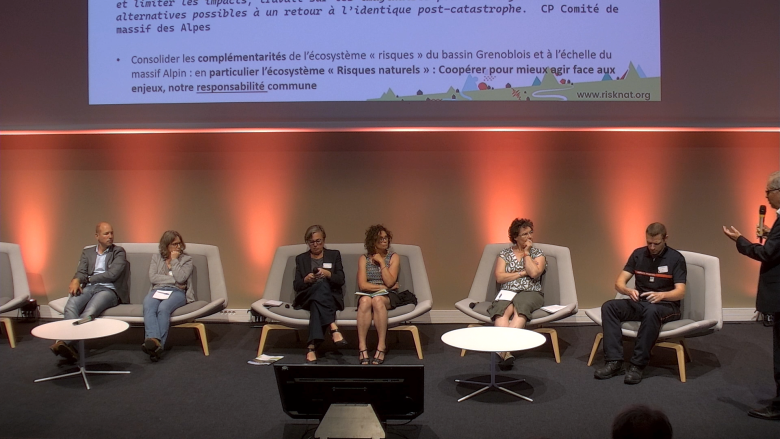
The presence of the Isère Departmental Fire and Rescue Service (SDIS 38) highlighted the importance of professional and volunteer firefighters (who account for 80% of personnel) in civil protection, as well as the constant relationships maintained with all organisations involved in risk science and management. The political steering of field operations was also discussed, and the concept of ergonomics was further developed. Ergonomics plays a significant role in managing social risks during the implementation of disaster management processes. It facilitates interactions between stakeholders and the consideration of their needs in the collective interest.
The growing difficulty of collecting observational data to support research projects was also emphasised. This disruption in observational data, caused by climate change, has reinforced the development of multidisciplinary partnerships, participatory science initiatives, and the deployment of low-tech instrumentation to multiply observation sites.
The multi-risk approach is increasingly integrated into public policies, and new hazards are beginning to be taken seriously, such as seismic risks in the Grenoble metropolitan area, which supports multi-partner research initiatives. While the academic community is increasing its presence alongside organisations responsible for risk management, scientific expertise still encounters difficulties in damage assessment. This is notably linked to the consideration of ageing infrastructure, which would require further instrumentation yet to be developed, potentially including citizen-based instrumentation.
Blind spots remain in risk management strategies, but numerous multidisciplinary studies are underway concerning multi-risk approaches and population management.
Speakers list with replay and presentations in French:
- Vincent Boudières, Head of the Risk Unit at Grenoble-Alpes-Métropole (replay / présentation).
- Florence Marchon, Director of the Alpine Centre for Studies and Research on Natural Risk Prevention (PARN) (replay / présentation).
- Lieutenant-Colonel David Marchandeau, Isère Departmental Fire and Rescue Service (SDIS 38) (replay).
- Cécile Cornou (IRD), researcher in seismic risk at the ISTerre Laboratory and the Risk Institute (replay).
- Sandrine Caroly (Grenoble INP – UGA), ergonomics researcher at the PACTE Laboratory and the Risk Institute (replay).
- Nathalie Cotte, Director of the Grenoble Observatory of Earth Sciences (OSUG) (replay).
- Michel Jaboyedoff (University of Lausanne), researcher in gravitational risks.
Full replay video
Grenoble Alpes Métropole: a territory of risks
As Head of the Risk Unit at Grenoble-Alpes-Métropole, Vincent Boudières presented the numerous risks faced by the Grenoble metropolitan area. Gravitational, hydraulic and NaTech risks in particular benefit from significant investments in prediction, awareness-raising and monitoring.
Starting from the observation that public policies, even when scientifically rigorous, can prove dangerous if they focus on a single risk, Grenoble Alpes Métropole’s position aligns well with integrated risk management as promoted by the Risques Programme (IRiMa), by placing a multi-risk vision at the core of its action.
For example, while the safety of hundreds of thousands of people is currently ensured by flood protection infrastructures, the central issue of urbanisation is increasingly shifting towards urban renewal that integrates multi-risk challenges, rather than continuing urban sprawl into territories that may become sources of risk.
Several tools are available to the metropolitan authority, enabling it to benefit from a comprehensive and multi-risk vision for implementing an integrated management plan:
- GEMAPI GAM, for real-time monitoring of flood protection systems and the protection of people and property in protected areas.
- The Graduated Anticipation Plan (PAG), applied to torrent crisis management.
- The Metropolitan Guide to Resilient Spatial Planning, developed in partnership with Cerema.
The Alpine Centre for Studies and Research on Natural Risk Prevention (PARN): a key actor in implementing territorial synergies in risk management
Established in 1988, PARN currently brings together nine research and study organisations dedicated to natural risks in the Rhône-Alpes region. Florence Marchon, Director of this association, was invited to this round table to present its various missions.
Working in close collaboration with all actors involved in risk management across the Alpine massif, PARN seeks to strengthen the role of scientists in societal decision-making and to foster synergy among Alpine stakeholders around new forms of habitability in exposed territories.
This activity operates at multiple scales with the stakeholders involved and aims to consolidate the complementarities of this ecosystem in order to enhance cooperation. To this end, integrated natural risk management has proven effective in supporting territories facing global changes. PARN provides a favourable framework for multi-actor collaboration by actively coordinating the network of Integrated Natural Risk Management Territories (GIRN), addressing issues related to tourism, and supporting adaptation to extreme phenomena.
Between 2024 and 2027, PARN will implement its strategic project aimed at deploying integrated natural risk management in mountain areas. This will notably include the valorisation of data from the Alpes-Climat-Risques platform, the strengthening of territorial and Euro-Alpine cooperation, and the facilitation of the TAGIRN (Alpine Territories for Integrated Natural Risk Management) and SDA (Science–Decision–Action for Natural Risk Prevention in the Alps) networks.
Inter-programme collaboration
Doctoral and post-doctoral projects—ranging from fundamental research to structuring research initiatives—are already co-funded by several of these programmes, with many more to follow. In addition, certain calls for projects may be of interest to a broad scientific community across different programmes, such as the still-open call for proposals under the eNSEMBLE programme (interdisciplinary research projects and post-doctoral projects) and the most recent call from the MathVives programme, which selected projects focused on extreme flood phenomena and climate modelling.
Numerous research topics related to the Risques Programme were also highlighted, including environmental risks and geothermal-induced seismicity (Subsurface), as well as a doctoral project on risk management (eNSEMBLE). Finally, all programmes stressed the importance of raising awareness within the media sphere regarding risk management and agreed on the value of organising meetings between scientific communities and journalistic communities to support awareness-raising efforts.
IRiMa Risks Research Program thanks the five represented programmes:
- VDBI – Ville durable (Sustainable city).
- Math-Vives – Mathématiques en interaction (Mathematics in Interaction).
- TRACCS – Climat(Climate).
- eNSEMBLE – Collaboration numérique (Digital Collaboration).
- FORESTT – Résilience des forêts (Forest Resilience).
- Sous-sol, bien commun (Subsurface, a common good).
Internal general meeting
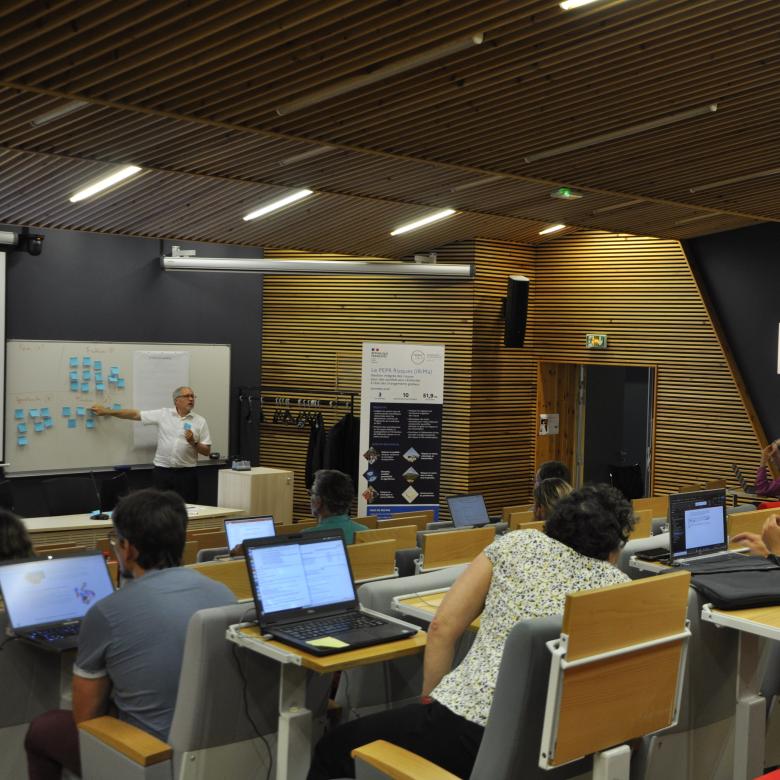
Interdisciplinarity workshop
Within the Risques Programme, interdisciplinarity has already yielded positive effects, such as opening up new research questions and fostering collaborative work on responses to calls for projects.
However, several limitations and areas for improvement were identified. Interdisciplinarity would benefit from being formally recognised as a major strategic issue, enabling it to be integrated from the project design phase and to increase its diversity, as some disciplines remain relatively distant from one another. To facilitate exchanges, the creation of a shared glossary and collaborative tools was proposed to enhance mutual understanding between disciplines that sometimes address similar topics and concepts using different vocabularies.
Opportunities were also identified, such as supporting creativity to foster agility in response to emerging challenges, through the organisation of workshops and seminars dedicated to interdisciplinarity, and by increasing joint actions among partners.
Nevertheless, interdisciplinarity faces countervailing dynamics, including limited recognition of interdisciplinary publications, scientific career models that remain insufficiently conducive to transdisciplinary profiles, and, at times, a degree of opportunism that can be detrimental to the genuine development of collaborative capacity.
International workshop
Given that international visibility is a central challenge for the programme, this workshop addressed the networks to be mobilised and the lobbying actions to be undertaken.
Despite recognised expertise and some presence within international networks, several current limitations were identified. At the national level, France’s position within the United Nations Office for Disaster Risk Reduction (UNDRR) and the limited visibility of the social sciences and humanities were highlighted as weaknesses, among others. The absence of programmatic legislation and insufficient awareness among decision-makers regarding scientific research on risk-related issues were also identified as factors potentially limiting the international visibility of the programme’s work.
However, opportunities exist. The approval by the United Nations General Assembly of the “Decade of Action for Cryospheric Sciences” could mobilise part of the scientific community. The Belmont Forum may also represent an attractive international platform for the programme. Furthermore, participation in international comparative studies, initiatives in scientific publishing and education, and enhanced visibility of the costs generated by disasters would help improve the programme’s international profile.
This workshop confirmed the need for the Risques Programme community to become more structured in the coming months in order to position itself as a major actor in French risk research.