

News

Challenges and objectives
Risk assessment requires a dedicated platform infrastructure to capture complexity, bring together the full range of necessary expertise, and enable cross-fertilization and knowledge sharing with a broad audience.
The Digital Platforms project proposes to provide a coherent set of interacting hardware resources for computation, storage, networks, connectivity, capitalization, sharing, and dissemination of data and codes developed within the various targeted projects of the IRiMa Risks Research Program. This set of platforms will contribute to the implementation of case studies and the demonstration of results obtained for the pilot sites of the program.
The project focuses on three scientific objectives:
- Formalize a digital modeling infrastructure based on existing French research facilities dedicated to massive data analysis and high-performance computing (HPC), to model the physical processes at play in natural, technological, or environmental disasters.
- Develop integrated multi-risk mapping platforms dedicated to producing hazard, vulnerability, and risk maps to support decision-making.
- Aggregate social and economic science methods into a shared web-based co-working tool for the processing and management of social information.
The project also aims to offer differentiated access and use of resources depending on the types of users, ranging from simple consultation to the development of digital models.
Key figures
-
7.00years
-
3.00scientific challenges
-
4.00axes
-
7.00partners
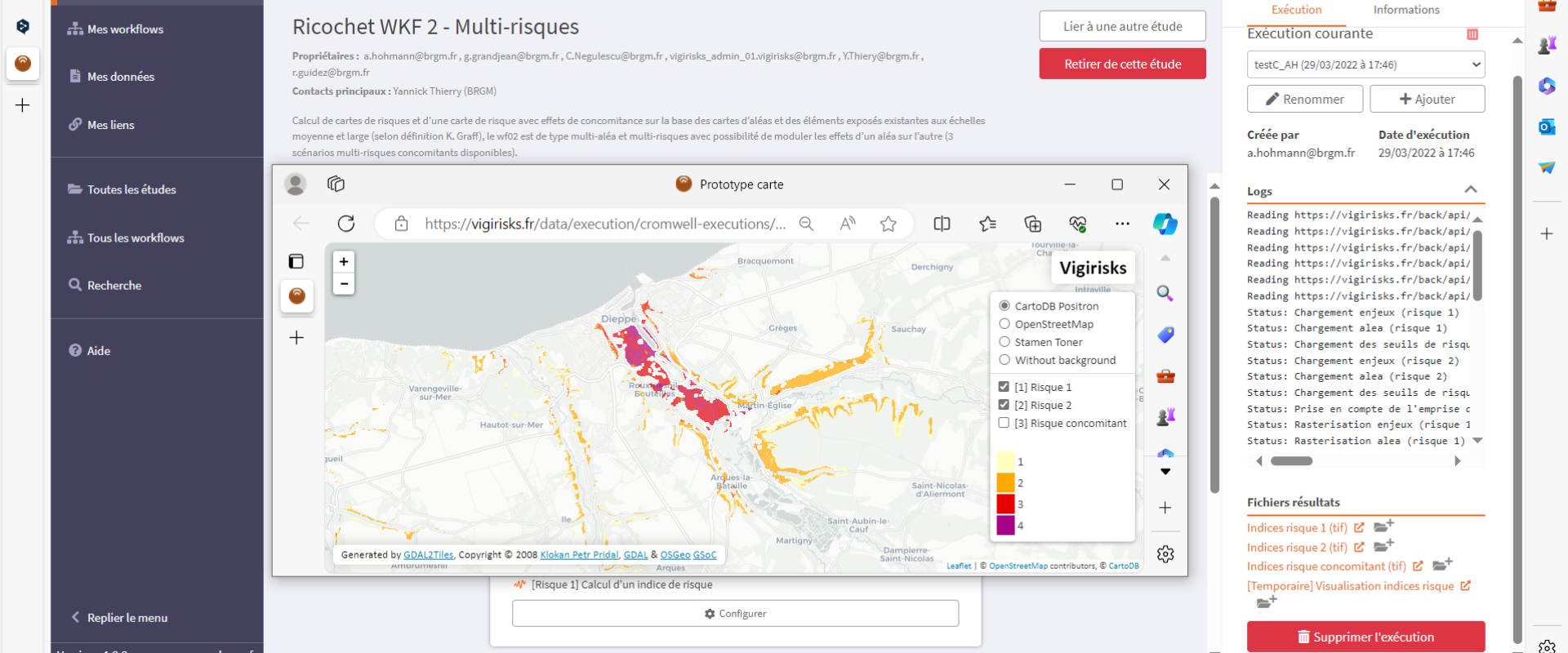
Plateforme VigiRisks
© Neglescu et al. 2023.
Axes and expected results
To achieve its objectives, the Digital Platforms project is structured around four axes:
Infrastructures
The first work package is dedicated to studying necessary functionalities and data access, defining interoperability, setting up the infrastructure and tools, and developing interfaces for the functional modules stemming from the second axis.
Functional modules
The second work package concerns the development of the platform’s functional modules. The project members will build on three prior achievements:
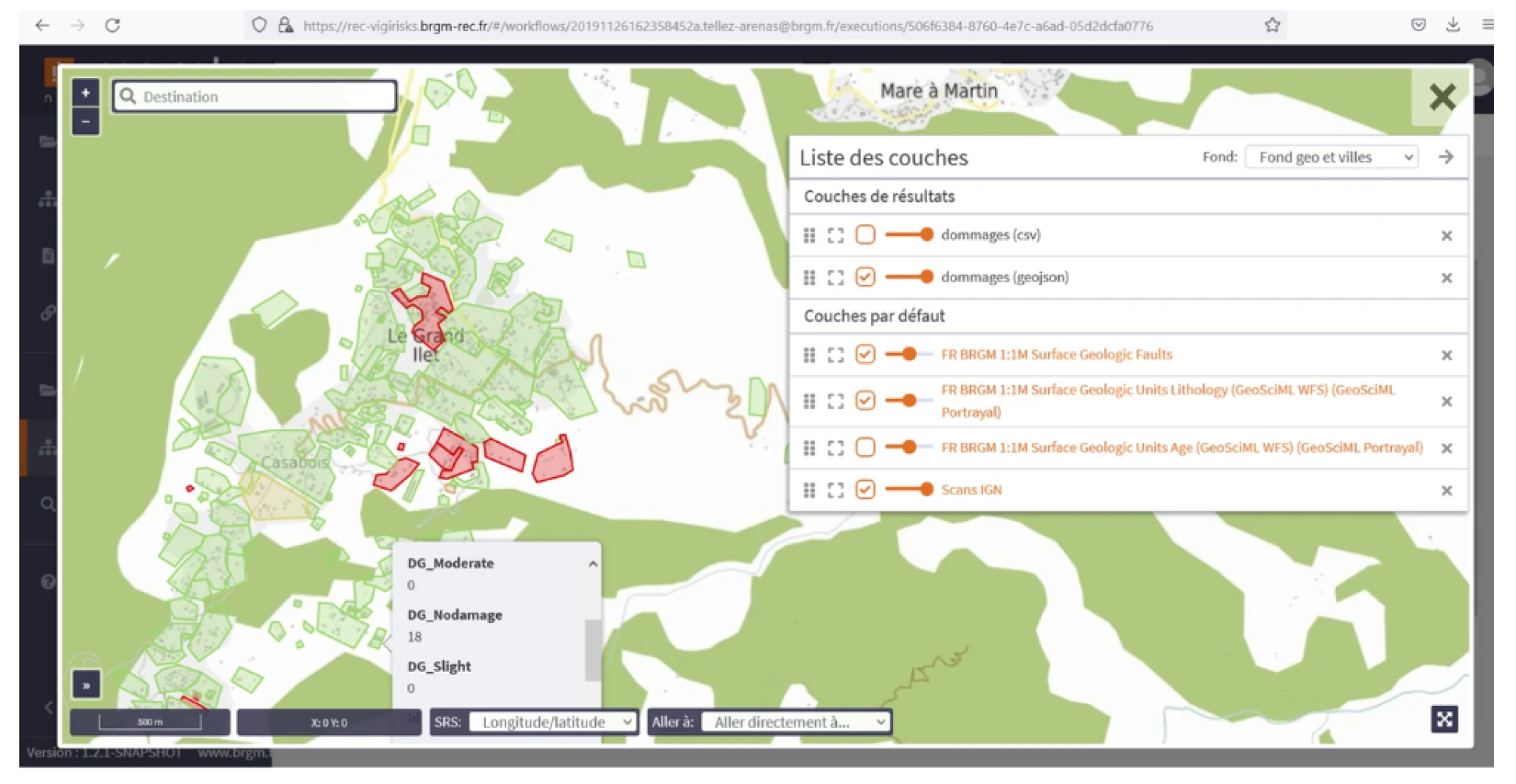
- The VigiRisks Platform (BRGM), dedicated to natural risks (Negulescu et al. 2023). It will be further developed in order to create workflows for transcribing multi-risk/multi-stakeholder scenarios. New functionalities will be implemented (e.g., dynamic workflows, specific web services, statistical and mapping tools at various levels of resolution, integration and processing of historical databases, or connection to storage spaces), based on the needs expressed by other targeted projects of the IRiMa Risks Research Program.
- Mira+ components (INERIS), dedicated to technological risks. MIRA+ represents a set of technical functionalities for assessing and/or managing technological risks: collecting various types of data on a given area (natural, urban, and industrial environments, infrastructures, networks, territorial conditions, and natural resources), intelligent document management based on ontologies, calculation of the consequences of hazardous phenomena, and characterization of domino effects in a complex system. These functionalities, currently embedded in various applications, will need to be transformed into application programming interfaces (APIs) and then into web services to be accessible via the platform developed in this project.
Two new modules are to be developed:
- Intelligent mapping, dedicated to developing artificial intelligence (AI) algorithms for identifying, mapping, spatializing, and measuring, in aerospace imagery, the natural and socio-environmental hazards and risks studied in IRiMa Risks Research Program projects. These algorithms must be adapted both to the identification of relevant objects and processes in the pilot sites (landslides, seismic faults, volcanic edifices and products, geological, morphological, and sedimentary markers of beach evolution, etc.) and at other sites worldwide where contexts and data types differ.
- Web 2.0, aimed at harnessing the potential of citizen-generated data (videos, texts, and social networks) to collect relevant information in the event of natural, industrial, or NaTech crises, e.g., damage/debris via images and videos, flow speeds during major floods via amateur videos, population perceptions, human mobility and behavior, population flows, etc. This module requires us to define expected services for the community, harvesting data and exploiting it for past case studies (e.g., the Lubrizol accident, Storm Alex, the Teil earthquake, the Türkiye earthquake, the seismic/volcanic crisis on Mayotte), extracting useful indicators and data for the scientific and operational community – particularly through AI methods – and ensuring interoperability with users and existing platforms/services.
Case studies
The third work package aims to define the structuring of thematic and multi-risk scenarios through workflows (chaining of multiple processes), gather the needs expressed by targeted projects for their case studies, develop the necessary software interfaces, make tools and functionalities accessible on the platform, and implement the scenarios there.
Training
Finally, the fourth axis is dedicated to analyzing current risk education mechanisms and identifying the needs and expectations of different audiences, in order to propose dedicated resources on the platform developed within the project. This axis is based on the observed lack of recommendations concerning content (knowledge to be prioritized), the most appropriate formats, and the modalities for implementing risk education. This is linked in particular to a sector-based organization of risks, often with an absence of cross-cutting proposals, and implementation tied to specific cases.
The project members aim to review available online teaching resources on risk education in France, for teachers and trainers, concerning seismic-volcanic risks, hurricanes, mountain and coastal risks, and cross-cutting approaches (prevention, adaptation, and resilience). They conduct interviews with the coordinators of different PEPR projects to determine which documentary resources can be made available on the platform, in line with the needs of target audiences.
The platform developed within this targeted project is intended to serve as the scientific workshop for partners and as the demonstrator of results throughout the program. Beyond that, it aims to contribute to bringing teams together around the analysis of risks, crisis scenarios, and the evaluation of simulation tools, decision-support tools, and experimental frameworks in collaboration with various stakeholders.
Project leader
Joël Langlois, Information Systems Engineer at BRGM.
With more than 30 years of experience, he first worked in the defense industry within the THALES group, contributing to the development of real-time architectures for the RAFALE fighter jet and associated simulation platforms. In 2005, he joined the Information Technology Department of BRGM as head of the software development unit, and participated in several European projects under FP6 (SWING) and FP7 (ENVISION), as Work Package Leader and BRGM project manager in the field of semantic platforms and decision-support infrastructures. He later joined the Prevention and Mining Safety Department to oversee the Information System and develop tools and resources for multi-domain data management.
Partners
- Université Nice Côte d’Azur
- Université Grenoble Alpes
- INRAE
- CNRS
- BRGM
- INERIS
- IRSN