
Challenges
Due to their physical specificities, mountain environments are prone to rapid and destructive natural hazards, often involving cascading phenomena such as coupled floods–storms–landslides, and emerging risks linked to glacier retreat. These territories are undergoing rapid societal transformations and exhibit significant vulnerabilities, particularly related to accessibility, which generates conflicts in land use and resource management.
Significant efforts have been deployed at the national level to observe, understand, model, and mitigate mountain risks. However, many specific physical and social processes remain poorly understood due to their complexity, the difficulty of observing these territories, and their rapid and profound transformations. As a result, there are still immense uncertainties regarding future projections, particularly at the local scale. Furthermore, mountain risk research often remains siloed, and management procedures mainly rely on the assumption that hazards and exposure do not change over time. The current context of rapid transitions challenges this assumption, as areas that were previously considered safe may later become hazardous. Risk mapping and spatial planning are therefore crucial for the future of these sensitive regions.
Key figures
-
7.00yars
-
6.00partners
-
4.00study areas
-
5.00pilot sites
Scientific scope
The IRIMONT project, carried out within the framework of the IRiMa Risks Research Program, addresses all physical and social dimensions of natural risks in mountain regions, from process characterization to decision-making and adaptation in the context of climate change and socio-environmental dynamics.
It focuses on the following issues:
- Knowledge gaps that hinder effective risk assessment and mitigation, including links between local and global scales.
- The long-term dynamics of risk evolution and its components, and the methods of integrating them into risk mapping and management.
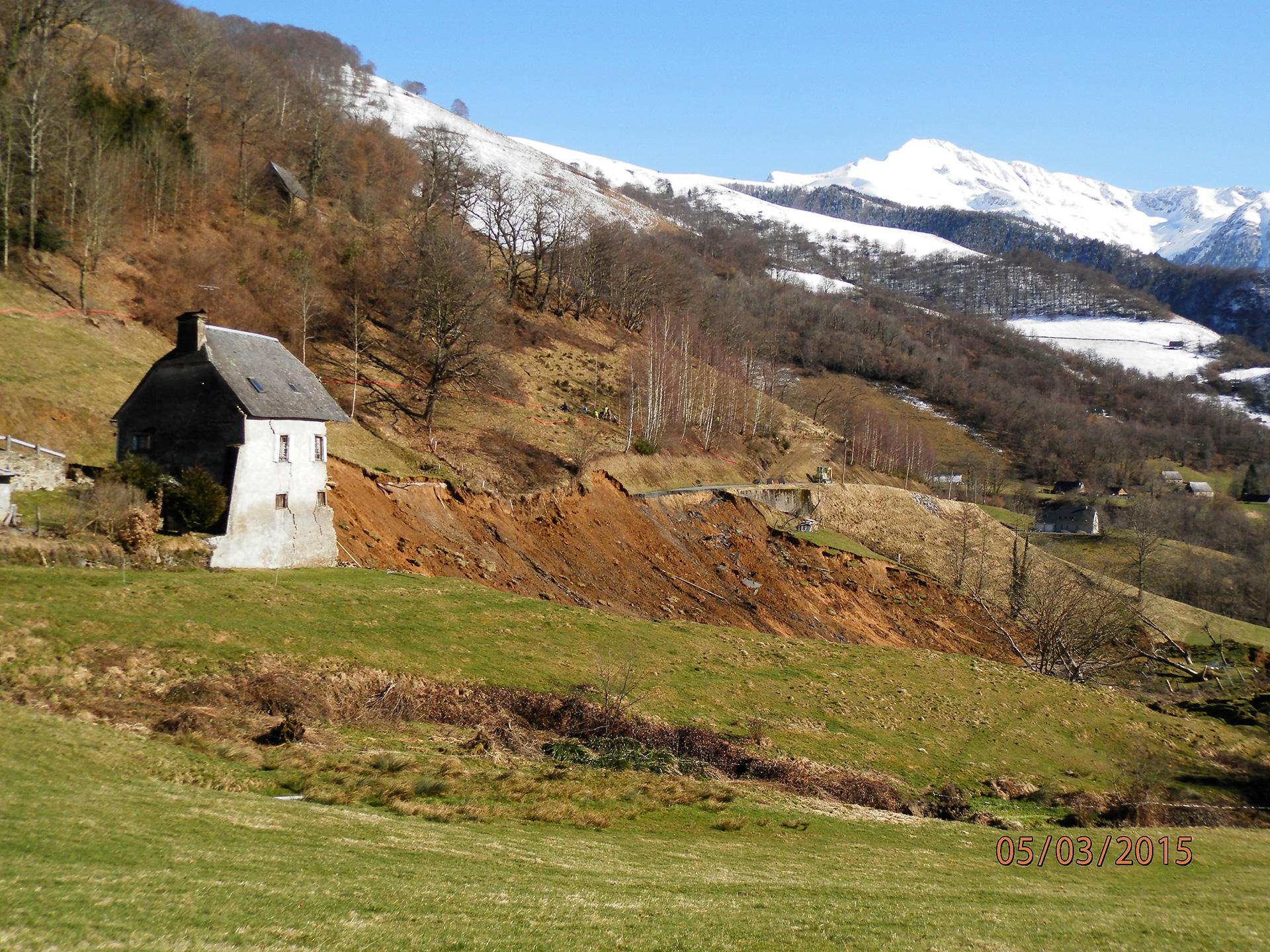
- Multiple cascading hazards, notably due to permafrost degradation, glacier retreat, and decreasing seasonal snow cover.
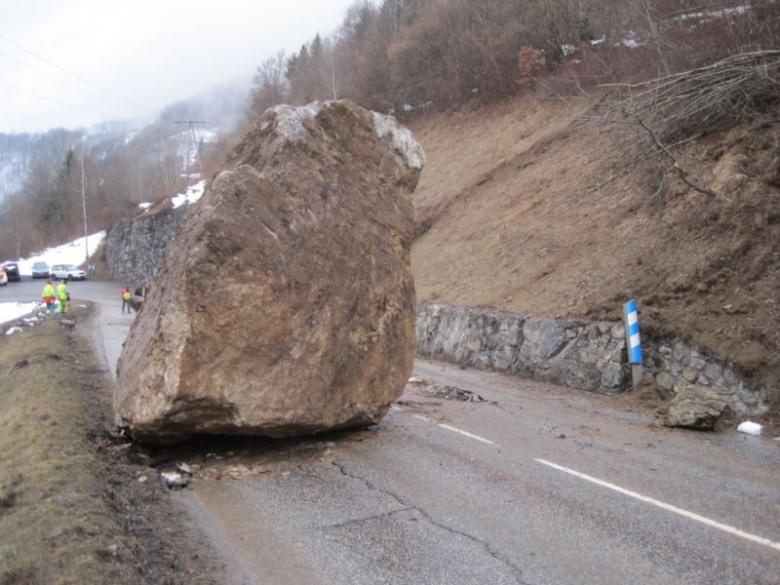
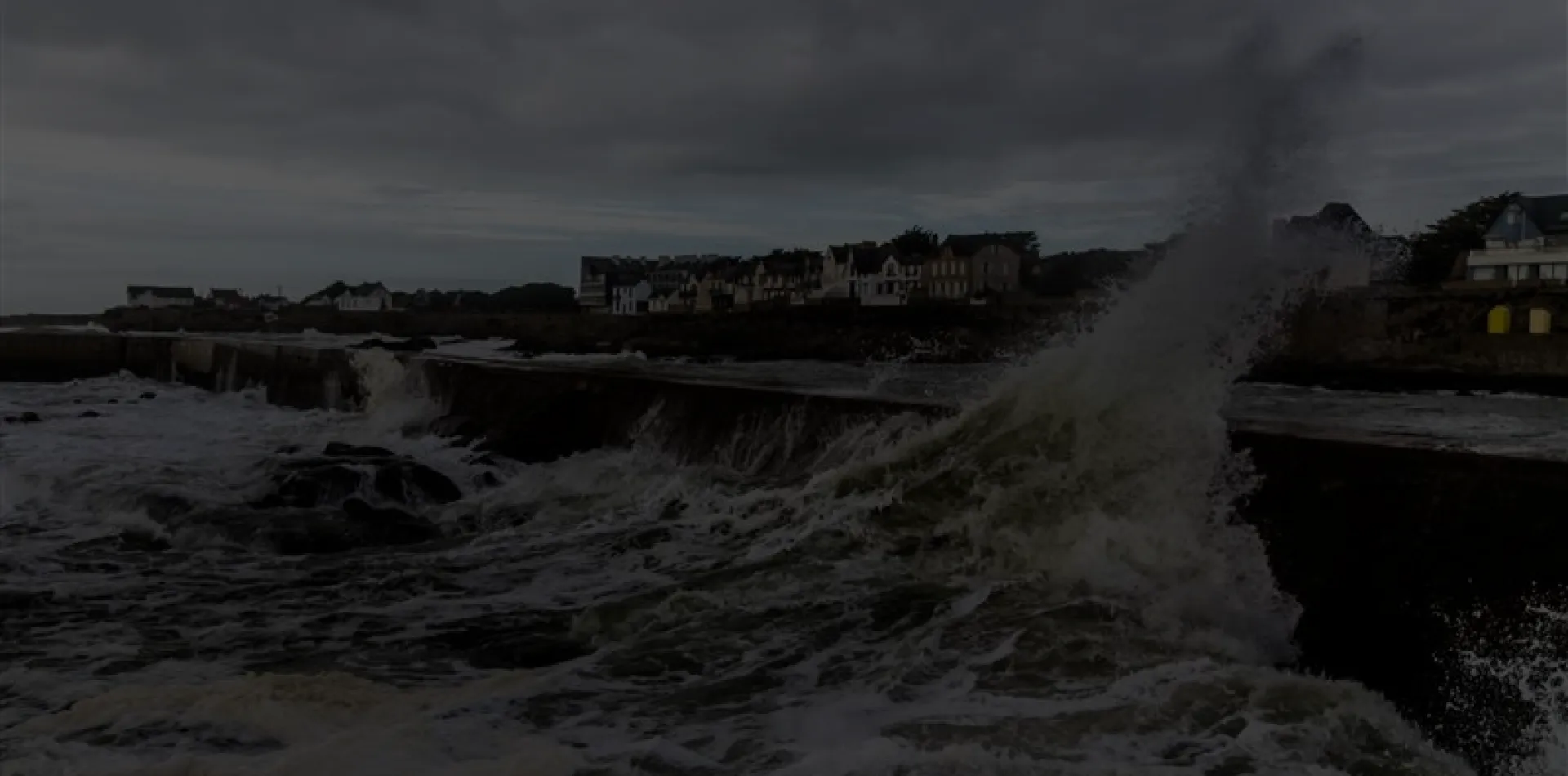
Bloc rocheux ayant atteint une route, Savoie, février 2014
© CD73, J.-P. Clatot. Publié dans Eckert, N., Mainieri, R., Bourrier, F., Giacona, F., Corona, C., Le Bidan, V., & Lescurier, A. (2020). Revue Française de Géotechnique, (163), 3
Objectives
IRIMONT is structured around four interdisciplinary research axes combining geosciences, humanities and social sciences, engineering, and data science.
It aims to:
- Produce innovative results on critical processes, the evolution of mountain risks and their components, especially emerging risks, and the methods that enable their understanding and anticipation.
- Strengthen a research community of excellence on mountain risks in France, building on leading institutions and universities, networking them, fostering interdisciplinary and inter-partner collaborations, and contributing to a new national strategy for understanding mountain risks by developing new tools for stakeholders.
- Develop future risk projections for target territories and pilot sites, with partial extrapolation potential.
- Consolidate this research within sustainable infrastructures and make it available to territories and national and international institutional and private actors.
Study areas
Research within IRIMONT focuses on various mountain territories in order to cover the full range of national contexts across France, while also incorporating an international perspective on very high mountain ranges:
- High mountain ranges in mainland France (Alps, Pyrenees)
- Medium mountain ranges in mainland France (Jura, Massif Central, and Vosges), which are distinct environments with sometimes different risk management approaches, and that can serve as “models” for anticipating future developments at higher altitudes under warming
- Very high mountain ranges (Andes, Himalayas), which concentrate high-magnitude and/or specific hazards and vulnerable populations. The occurrence of large-scale hazards (cascading phenomena) can also provide insights for anticipating potential catastrophic events in mainland territories
- Mountain areas addressed by the Overseas Risks targeted project of the IRiMa Risks Research Program, focusing on hydro-climatic and gravitational hazards.
Within these areas, five pilot sites have been identified to enable the mobilization and demonstration of the approaches and tools developed.
The IRIMONT project members develop synergies and joint activities with other targeted projects of the IRiMa Risks Research Program, in order to avoid thematic and methodological silos. Planned activities include shared study areas with the Overseas targeted project, methods development with the NaTech Risks, IRIMONT, and Digital Platforms projects, as well as data capitalization and co-constructed topics with other targeted projects of the IRiMa Risks Research Program.
Co-leaders
Nicolas Eckert (INRAE/Université Grenoble Alpes) coordinates the IRIMONT project. He is a researcher at UMR IGE in statistics applied to mountain risks, specializing in quantitative methods for risk assessment and the integration of climate and socio-environmental change impacts on risks. He is also co-leader of the University of Grenoble Alpes Risk Institute (with Sandrine Caroly and Cécile Cornou).
Vincent Jomelli (CNRS) co-directs IRIMONT. He is a research director at CEREGE, specializing in dynamic geomorphology of mountain regions, and studies the response of natural hazards to climate variability. He is also an expert on the long-term evolution of glaciers using geochronological approaches.
Parterns