

Context and objectives
In the face of climate change, the strategy for decades consisted primarily in prioritising mitigation, by seeking to limit the effects of climate change through tackling its causes. Over the past ten years, however, the need for adaptation has taken on a prominent place on the international and national political stage. A growing body of research and government reports has shown that responses to global change — of which climate change is one component — must now address both mitigation and adaptation.
Yet, despite their inclusion in numerous reports (IPCC, COP, international agreements), the notions of adaptation and resilience remain poorly defined and still little applied. Adaptation strategies often remain piecemeal and confined to the scale of a city, a neighbourhood, or a socio-ecosystem, and/or focused on a particular hazard, making it difficult to account for systemic risks. Research questioning the adaptation and resilience of territories in a context of global change — of a changing, uncertain environment, of compound risks and interacting scales — remains rare.
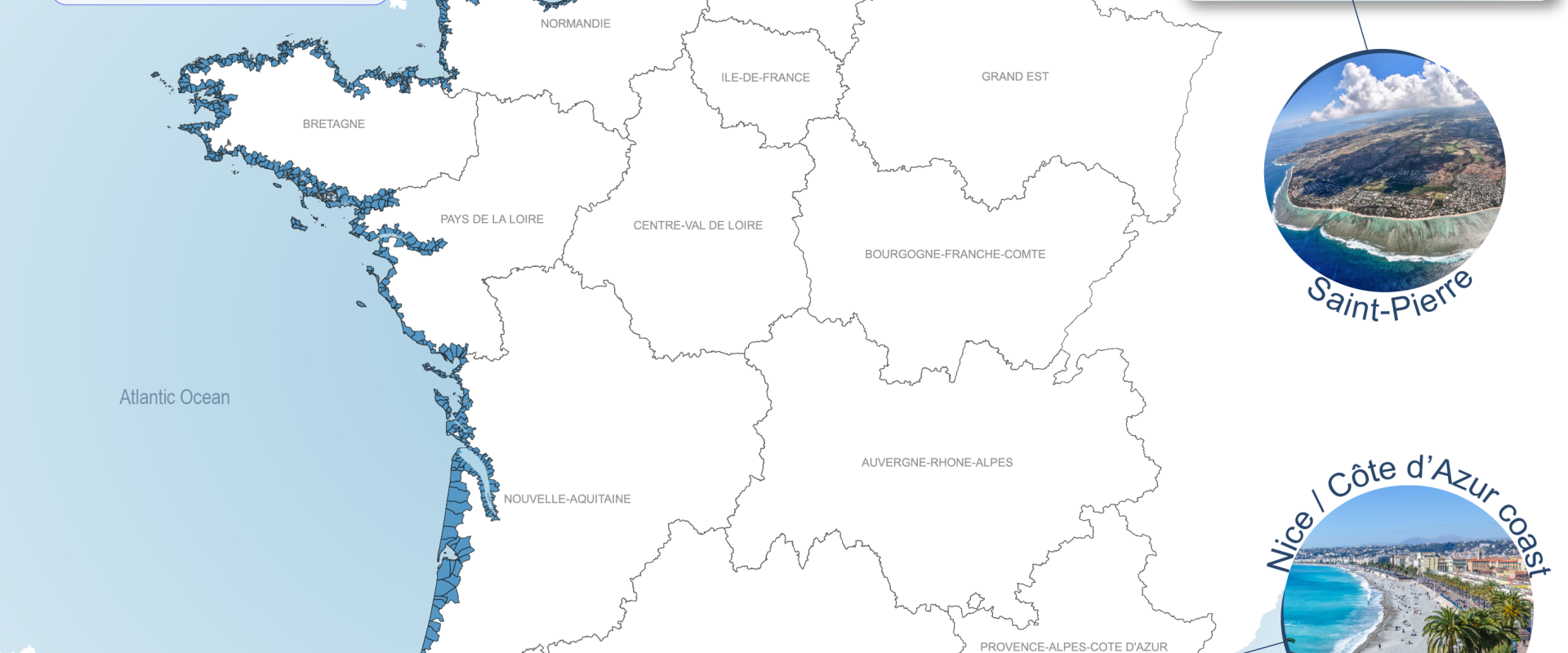
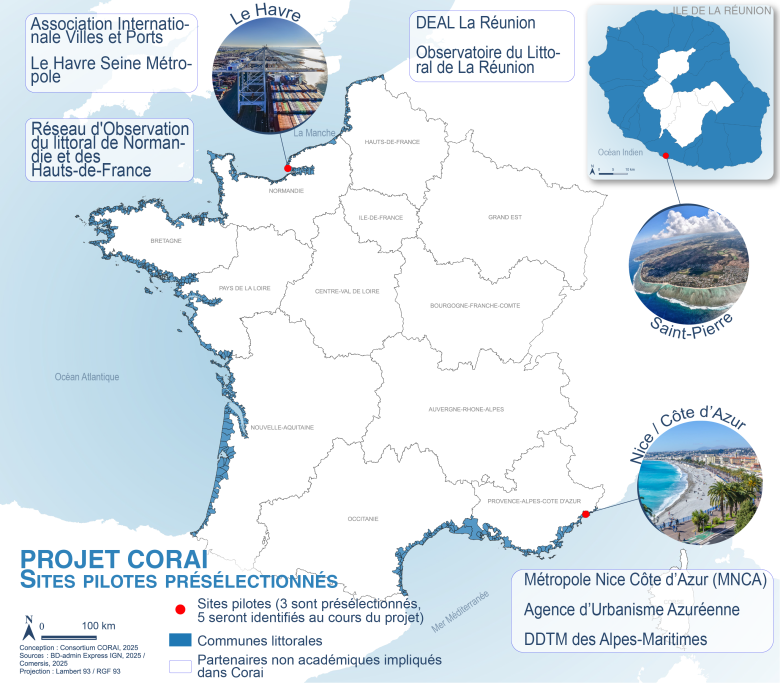
The CORAI project therefore aims to fill this gap. It will produce coherent scientific and operational responses to the specific adaptation and resilience challenges facing French coastal zones (mainland France and Réunion Island) confronted with global change: these territories are attractive and often densely populated; they are characterised by a concentration of multiple terrestrial and maritime activities, by the presence of major cities and essential infrastructure — port infrastructure in particular — but also by unique social ecosystems. We therefore propose a systemic, multidimensional, and multi-scale approach that goes beyond a sectoral approach to risk and will provide tools (TRL 4–7) capable of supporting different forms of adaptation.
For each French coastal region (Mediterranean, North Atlantic, the Channel, and the Indian Ocean), two pilot territories will be selected to co-construct knowledge, test the tools (indicators and a decision-support portal), and investigate the representations and emotions of the target stakeholders — the latter remaining little explored, even though they strongly influence the social acceptability of planning and adaptation strategies.
We propose an integrated research approach that combines the expertise of field stakeholders with the scientific and methodological insights of the humanities and social sciences, the Earth and marine sciences, and geomatics. This inter- and transdisciplinarity is a key innovation of the project.
Expected outcomes
The CORAI project will offer new elements of analysis, understanding, and operationalisation in order to demonstrate that adaptation strategies are possible and to strengthen resilience along French coastal zones. In keeping with the programme's objective of fostering interdisciplinary research to improve risk governance and support public decision-making, CORAI will provide a new understanding of the stakes and challenges of adaptation, and will develop methodologies and tools applicable to pilot coastal territories, drawing on existing knowledge of present and future coastal hazards.
Some specific expected outcomes:
- A typology of forms of adaptation set against the types of coastal territories and the diversity of hazards (natural, technological, etc.)
- A methodological framework for systemic and evolving adaptation of coastal zones
- A diagnosis and maps of the diversity of coastal risks (land–sea continuum) across the four French coastal seaboards (Mediterranean, North Atlantic, the Channel, and the Indian Ocean)
- Psychosocial profiles based on how stakeholders perceive the issues and on their level of support for proactive policies
- The operationalisation of resilience through a set of composite indicators
- An atlas of the implementation of adaptation and resilience indicators at the pilot sites, intended for local stakeholders and a diverse audience
- The production of notebooks and tools to support decision-making and help stakeholders anticipate and respond proactively to the challenges of adaptation
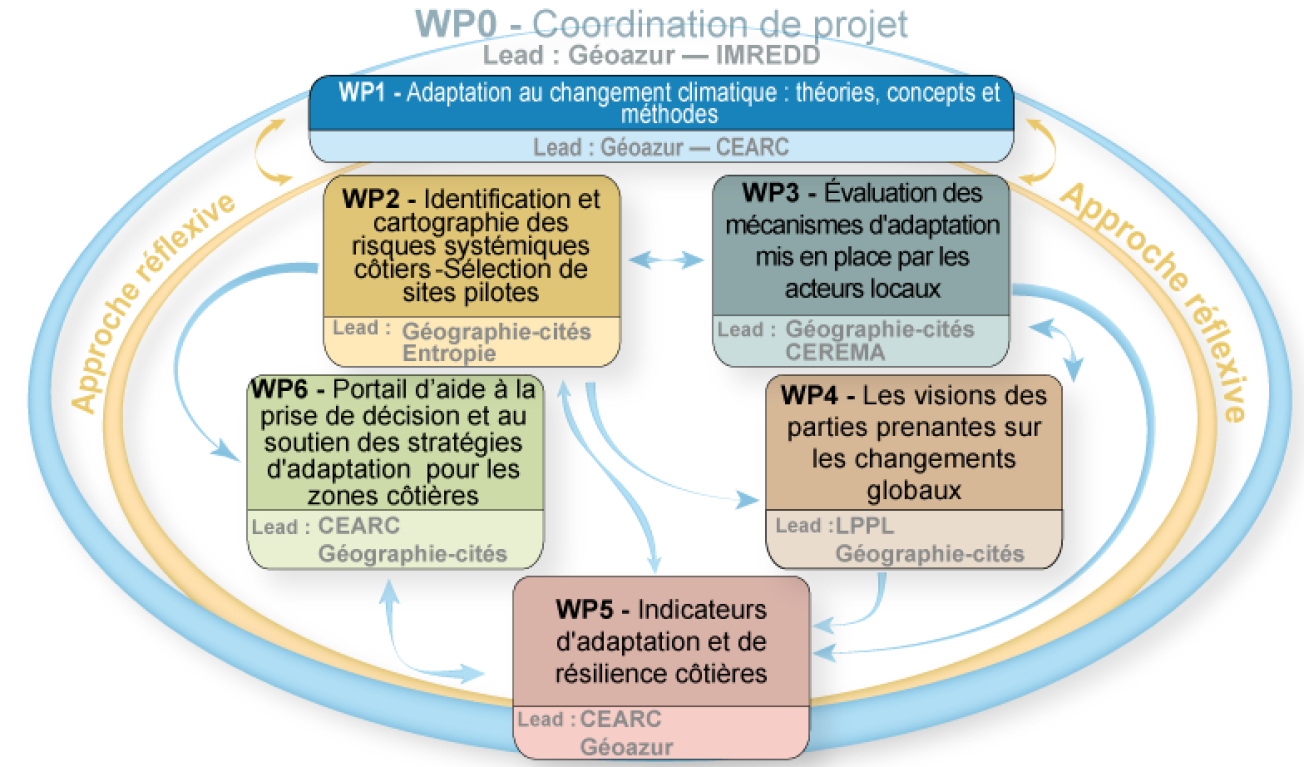
Project organization
Project leader
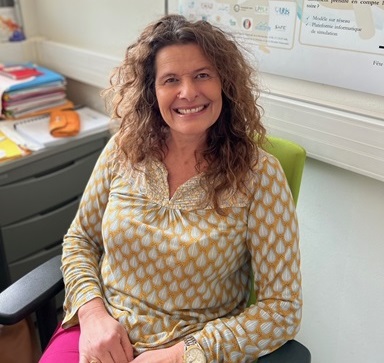
Damienne Provitolo (CNRS), geographer and Senior Research Scientist at the CNRS
Damienne Provitolo
Damienne Provitolo
A geographer and Senior Research Scientist (directrice de recherche) at the CNRS (INSHS) within the Géoazur joint research unit (INSU), D. Provitolo co-leads the team "Risks on a changing planet: functioning and resilience from land to sea" (a partner of the CORAI project). Her research addresses risks, disasters, and global change, as well as societal and territorial vulnerabilities and resilience. These themes are approached from a systemic, territorial, mathematical, and decision-oriented angle.
She has served as scientific lead on several interdisciplinary projects, including the ANR project Com2SiCa (Understanding and Simulating human behaviours in territories in disaster situations: from analysis to anticipation, 2018–2022), the Idex project of Université Côte d'Azur (Natural disasters and mental health – Rebuilding territories and repairing the living), and the CNRS-PEPS HuMaIN, within which she coordinated teams of researchers from the humanities and social sciences (geographers, psychologists, and geomaticians), the Earth sciences (geologists and geophysicists), and the mathematical sciences. She chairs the Local High Council for Climate and Biodiversity of the Nice Côte d'Azur Metropolis (since 2023), and in this capacity has collaborated with experts from many disciplines on the development of the Adaptation Strategy for this Mediterranean territory. She served a four-year term as vice-chair of the ANR Scientific Evaluation Committee "Global security, resilience and crisis management, cybersecurity" (2020–2023).
Partners