

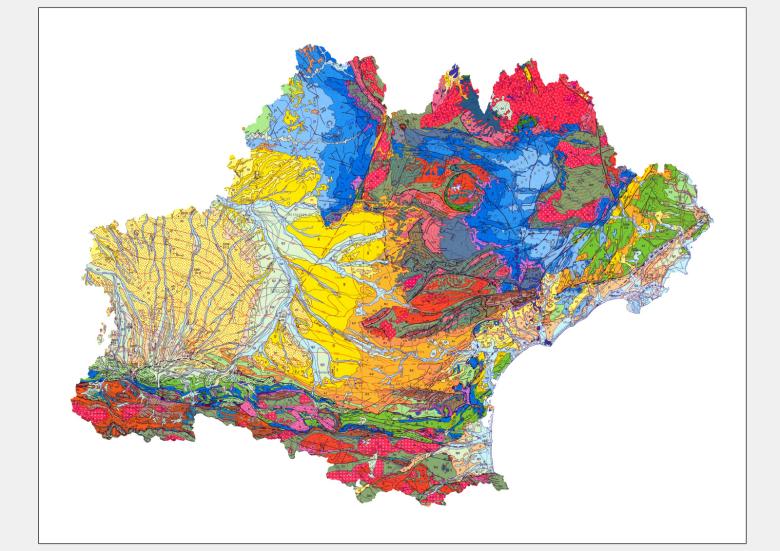
Geological Map of the Occitanie Region
BRGM
Context and objectives
Combining approaches from the geosciences, the humanities and social sciences, and the environmental sciences, the HYDROCLIMAT'OC project addresses the challenges of adapting the governance and management of disaster risks to the new hydroclimatic regime. This regime entails both the intensification and the chronicisation of extreme events (heavy rainfall, floods, droughts, wildfires) and new configurations of cascading and entangled risks, linked to the accelerated weakening of infrastructure, to the increasing quantity of contaminants in circulation, and also to forms of economic decline. It profoundly destabilises risk governance and management. The local scale — the regional scale in particular — is today regarded as crucial for responding to these disruptions and making adaptation operational. This is why the project takes as its laboratory Occitanie, the region of mainland France most affected by these phenomena.
The project sets four objectives:
- The first concerns a better understanding of the biophysical phenomena at work at the regional scale, and a contribution to the development of a new science of risk under the new hydroclimatic regime.
- The second aims to move beyond current risk governance and management, which are siloed and predicated on an assumption of hydroclimatic stationarity.
- The third corresponds to a critical analysis of the managerial and technological solutions and innovations currently being promoted, and of the possible associated risks of maladaptation.
- The fourth, finally, is one of generalisation from the various configurations found within Occitanie, in order to help develop and implement new forms of action that jointly reduce the different — and most often entangled — disaster risks and hazards generated by hydroclimatic upheaval.
Expected outcomes
The interdisciplinary work carried out within HYDROCLIMAT'OC will bring together the biophysical sciences and the humanities and social sciences. It will also be built on interactions, in a variety of formats, not only with industrial or public actors, but also with those whose practices or living spaces are vulnerable to disaster risks, or who identify hazards differently.
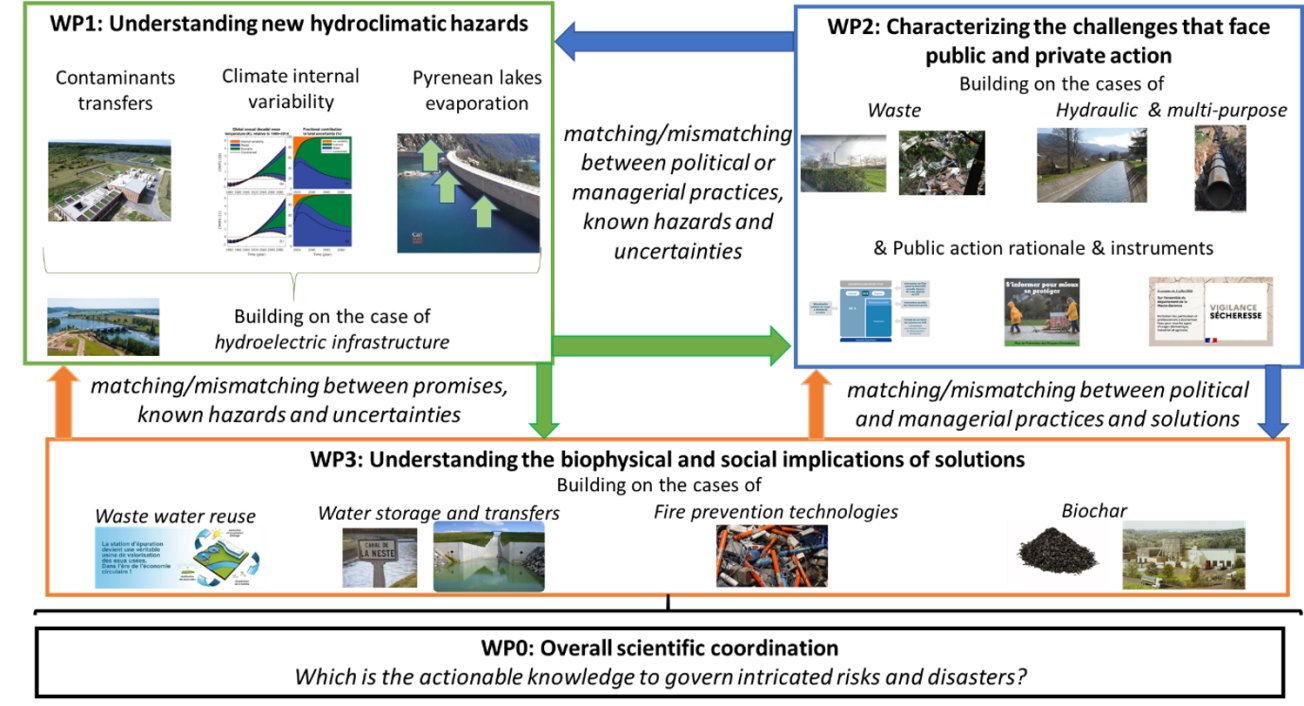
The expected outcomes involve a better understanding of some of the crucial yet still relatively little-explored biophysical mechanisms that characterise the new hydroclimatic risks at the regional scale: the internal climate variability that dominates the evolution of precipitation over the coming decades; the trajectory of contaminants in soils, through experimental innovations drawing on the ECOTRON facility at CEREEP; and the evaporation of lakes.
The project will also make it possible to better grasp the forms of destabilisation and recomposition of public, collective, or private action in the prevention, management, and adaptation of and to increasingly interwoven risks, drawing on the case of infrastructures dedicated to water supply for different uses, to waste management, and to hydroelectric production, as well as on a study of the public-policy instruments dedicated to the management of droughts and floods.
The project will further produce a critical analysis of the technological and managerial solutions and innovations currently promoted or trialled, drawing on the cases of the reuse of treated wastewater, water-storage and water-transfer infrastructures, technologies dedicated to managing fire risks at waste-treatment sites, and biochar. This analysis will rest both on a better understanding of the biophysical mechanisms associated with these solutions and on the identification of their sociotechnical characteristics.
By accounting for the processes of technology selection and beneficiary selection that these solutions entail, the analysis will render more legible the vulnerabilities that will not be mitigated, that will be created or exacerbated, as well as the uncertainties or forms of ignorance that these solutions contain. The expected outcomes thus aim to pluralise the range of possibilities with regard to the governance and management of disaster risks.
Project organization
Project leader
Sara Fernandez (INRAE), Chief Engineer of Bridges, Waters and Forests; Research Scientist (HDR) in Geography
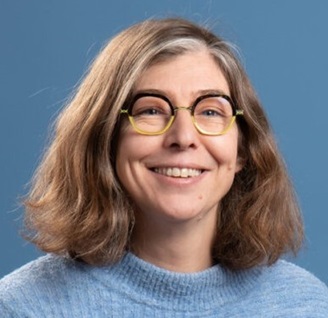
Sara Fernandez
Sara Fernandez
Sara Fernandez is a Chief Engineer of Bridges, Waters and Forests and holds an accreditation to supervise research (HDR) in geography (Université Paris 1 Panthéon-Sorbonne). For some twenty years, her research, in the field of the social study of science and technology, has focused on the relationships between knowledge, public action, and infrastructure in the water domain: scarcity, pollution, and aquatic environments (https://cv.hal.science/sara-fernandez).
She has been part of various scientific collectives at AgroParisTech, the École des hautes études en sciences sociales (EHESS), the Institut national de recherche en sciences et technologies pour l'environnement et l'agriculture (Irstea), and subsequently the Institut national de recherche pour l'agriculture, l'alimentation et l'environnement (INRAE), in Montpellier, Paris, Strasbourg, and Toulouse. She also worked for several years for international cooperation organisations — the FAO (Food and Agriculture Organization of the United Nations) and Plan Bleu, UNEP-MAP (United Nations Environment Programme–Mediterranean Action Plan) — in particular on the quantification of the relationships between water and agriculture and their prospective uses in the Mediterranean region.
In addition to coordinating HYDROCLIMAT'OC, she is involved in an ANR project (BlueState) and in a project funded by the Adour-Garonne Water Agency (BAGHEERA). She also co-leads one of the targeted projects of the PEPR OneWater (PC3 – OBSWATERS). She has developed solid experience in Master's-level teaching on water, waste, and risk policy and management, and in the supervision of early-career researchers (doctoral and postdoctoral). She is currently a member of the Scientific Councils of the Adour-Garonne Basin Committee and of the Institut national du service public (INSP). She also chaired the Scientific Council of the Rhin-Meuse Basin Committee for four years, having been a member of it for eleven years. For six years, she was co-director and then director of a joint social-sciences research unit specialising in water and waste governance in Strasbourg (UMR GESTE). Since January 2025, she has conducted her research within a multidisciplinary joint research unit specialising in agroecological transitions in Toulouse (UMR AGIR).
Partners