
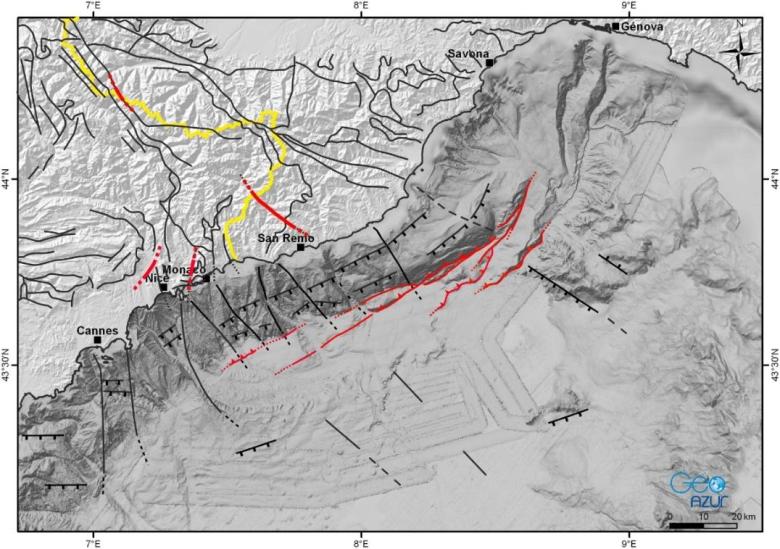
Map of faults in the Ligurian Basin and Southern Alps region. The French-Italian border is indicated by the yellow line, and the other lines represent the paths of the major known faults. Active faults are highlighted in red, including the Ligurian Fault offshore.
Géoazur
Context and objectives
Earthquakes are the most devastating and deadly natural disasters in the world. In France, however, seismic risk is often overshadowed by more frequent phenomena such as floods and storms. Yet the recent moderate-magnitude earthquakes (M~5) at La Laigne and Le Teil illustrate the level of disruption such events can cause. In a more densely populated area, a similar or larger earthquake would result in more severe loss of life, material damage, and economic disruption. When such an event occurs, decision-makers need reliable information quickly in order to coordinate relief operations and request external support (the critical survival window being 48 hours).
Over the past decade, the availability of real-time seismic data has improved considerably in Europe thanks to the EPOS research infrastructure. However, despite these technological advances, decision-makers in France still encounter major difficulties in accessing and integrating this information during seismic crises, particularly in order to guide the initial response and public communication.
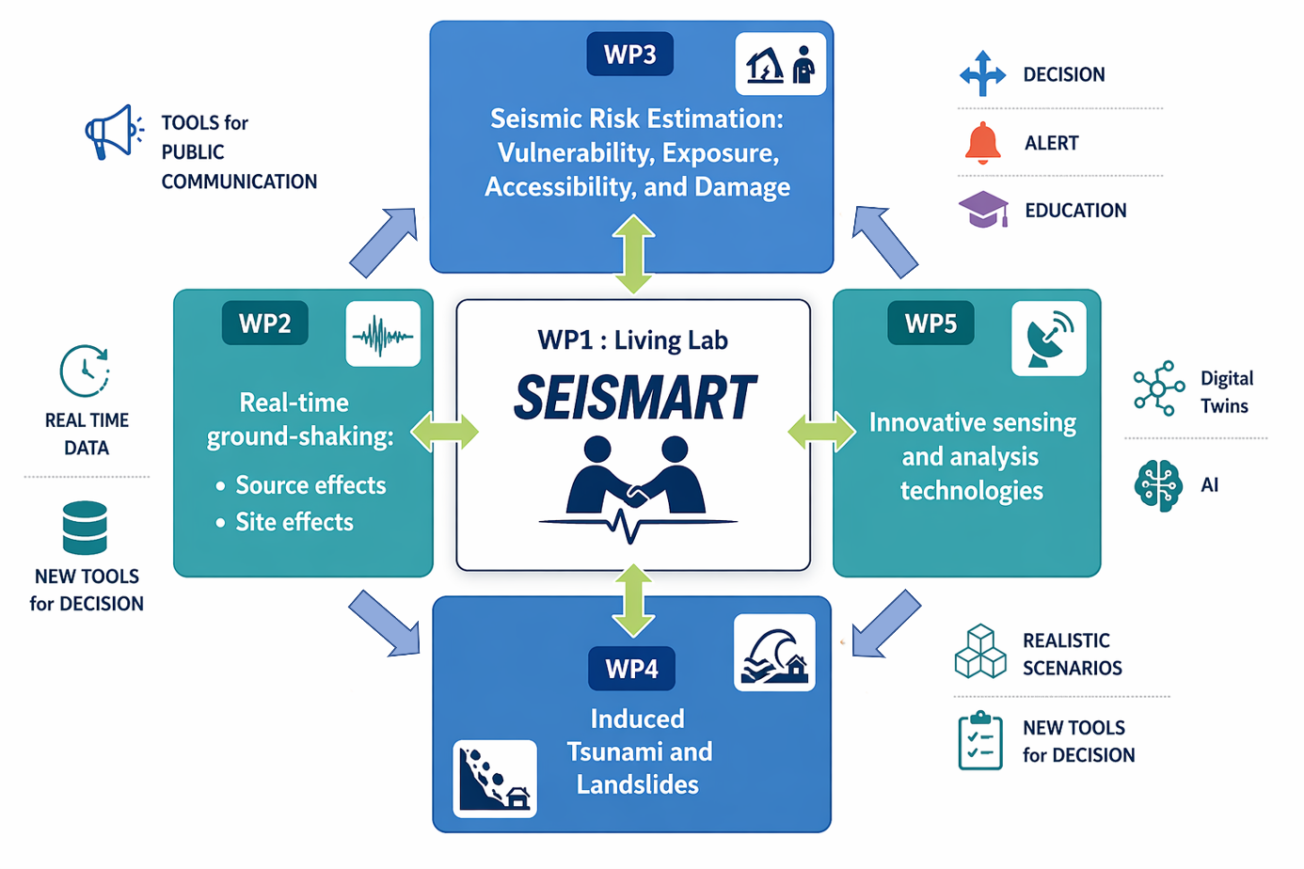
The main questions addressed in the SEISMART project are:
- What types of information are most relevant to communicate to disaster-risk-management (DRM) and civil-protection (CP) stakeholders, and in what form should they be transmitted?
- How can data and procedures be improved in order to increase the reliability of short-term forecasts of losses, damage, and network disruptions?
- What key messages must be rapidly conveyed to the population following an earthquake or a tsunami?
To meet these challenges, the SEISMART project aims to:
- foster continuity between data, models, and decision-making in order to optimise rapid decision-making and crisis communication in the event of an earthquake and/or tsunami;
- create a working group bringing together researchers and practitioners in disaster-risk management (DRM) and crisis communication in a climate of trust, and pool the skills of the various participants for a comprehensive approach;
- improve knowledge of hazards and vulnerabilities in the mountainous and coastal areas of the Mediterranean Sea through advanced research and new data;
- integrate educational, communication, and awareness-raising actions at every stage of the project.
The project focuses on a single geographical area, the Côte d'Azur, and on a single main hazard — the earthquake — together with its induced effects (tsunamis and landslides), in order to enable the implementation of a genuine "Living Lab" approach, fostering in-depth collaborative work within a multidisciplinary team of researchers, engineers, and risk professionals.
Expected outcomes
The expected outcomes are:
- new data and improved knowledge of hazards and vulnerability in the Alpes-Maritimes;
- a quantification of earthquake-related losses and damage using indicators validated by end users;
- high-performance simulations of induced effects (tsunamis and landslides);
- improved availability of rapid-response and early-warning tools, as well as guidelines for seismic-risk management planning, strengthening their integration into decision-making processes at different levels;
- the creation of strong links between researchers and practitioners in risk management and civil protection (DRM-CP), rapidly activatable when needed.
The results will be disseminated through publications in international journals (as well as popular-science publications for a wider audience), participation in conferences, and reports. A demonstrator will also be developed, one that can be used elsewhere (in France or abroad). The project supports training by involving doctoral students, postdoctoral researchers, engineers, and students, thereby fostering the emergence of a new generation of interdisciplinary researchers.
For the general public and schools, awareness-raising activities will be carried out, such as public lectures, workshops, media appearances, and participation in events such as the "Fête de la Science" organised by the Ministry of Higher Education and Research, the "Resilience Day" organised by the Alpes-Maritimes department, and others. A partnership with secondary-school teachers will be established throughout the project.
In keeping with the programme's objectives, the project strengthens scientific and technical capacities in the analysis of geophysical hazards by integrating the geosciences, engineering, data science, and the social sciences within shared, open, and reproducible infrastructures. The main scientific outcomes include interoperable datasets, as well as transferable models and methods that will be integrated via IRiMa's platform project (PC) and the associated data infrastructures, in order to ensure their accessibility and reusability. The project also strengthens the science–practice interface through co-design and continuous engagement with operational partners, following a "living lab" approach.
Project organization
Project leader
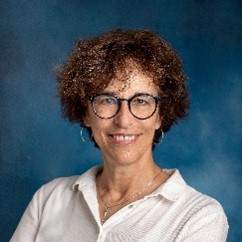
Françoise Courboulex (CNRS), Senior Research Scientist at the CNRS, specialist in understanding the processes linked to the deep genesis of earthquakes and the surface ground motions responsible for damage to societies
Françoise Courboulex
Françoise Courboulex
Françoise Courboulex is a Senior Research Scientist (directrice de recherche) at the CNRS. Her scientific work addresses the understanding of the processes linked to the deep genesis of earthquakes and the surface ground motions responsible for damage to societies. She works with real data and with models and simulations, in various countries: Haiti, Ecuador, Italy, and France. She is also interested in the links between science and society through multidisciplinary, citizen-science, and educational projects.
She is currently deputy director of the Géoazur laboratory, located at Sophia Antipolis near Nice. For seven years she led the team "Earthquakes: processes, forcings, hazards". She has supervised 15 doctoral students and is the author of some sixty scientific articles in international journals.
Partners