


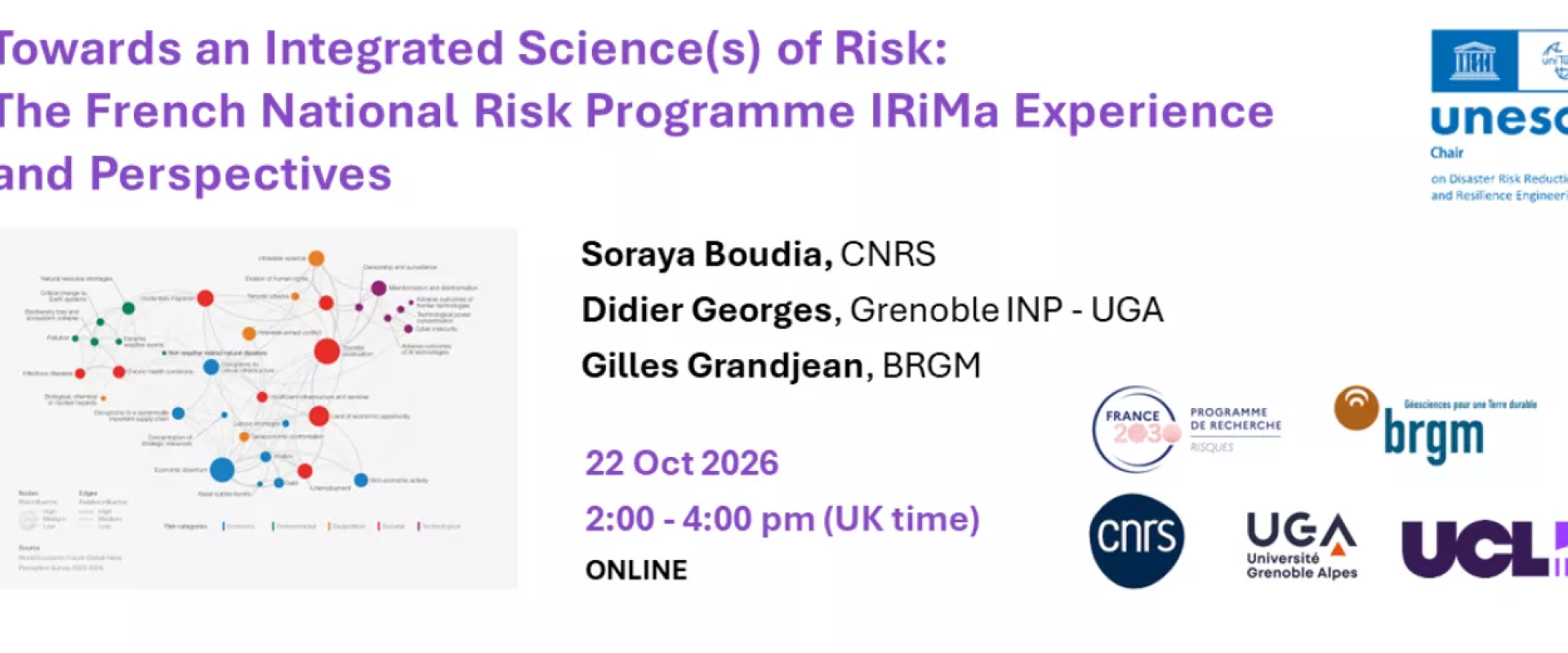
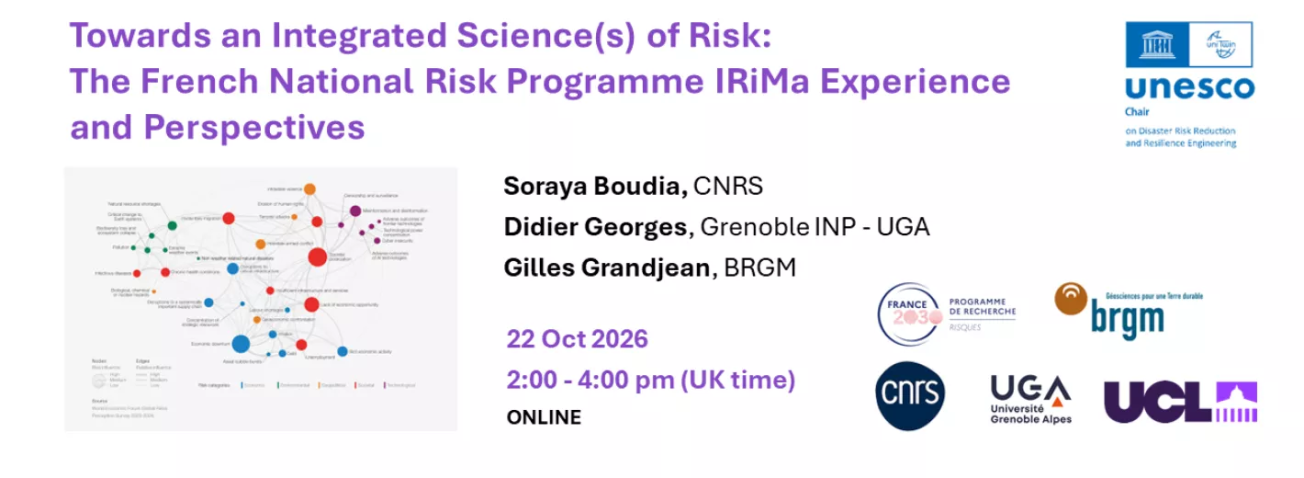
Global changes are transforming the risk landscape, with climate change, environmental degradation, technological development, and societal transformations generating increasingly interconnected, cascading, and systemic risks. These challenges call for an integrated risk science that goes beyond traditional approaches.
The Risques (IRima) program is internationally recognized for its method of developing such an approach, by bringing together geosciences, environmental and climate sciences, engineering, digital and data sciences, as well as human and social sciences. This, with the ambition to connect knowledge, decision-making and action while strengthening collaboration between research communities, stakeholders and citizens.
This intervention aims to discuss what “integration” means. Indeed, a central challenge is the lack of a shared understanding of this concept. To address this challenge, the program explores three complementary levels:
- the integration of the different dimensions of risk;
- the integration of the full risk management cycle, from prevention and preparedness to crisis management, reconstruction, and adaptation;
- the integration of risk management into broader societal, economic, and ecological transformations.
This contribution will present the lessons learned from the implementation of the program and discuss the scientific, methodological, and organizational challenges related to the design and implementation of an operational integrated risk science.
This webinar is organized by the UNESCO Chair in Disaster Risk Reduction and Resilience Engineering (DRR & RE), led by Dina D'Ayala (University College London) and member of the international scientific committee of the program.
Find the conference by Dina D'Ayala during the 2026 scientific days below.
Her presentation on Disaster Risk Reduction and Resilience Engineering presented a project on educational continuity in Mindanao (southern Philippines). The approach involves several steps. First, it characterizes the structural vulnerability of schools to earthquakes and flooding, using the GLOSI framework developed with the World Bank (building taxonomies → typologies → fragility curves). She emphasizes that this approach, well-established for seismic risk, must be extended to flood risk, where analytical resources are scarcer (relying on national hazard maps and empirical curves, up to repair costs based on water height).
Key point: educational resilience is not just about the state of buildings. The community must be able to reach the school — hence the importance of the road network and bridges (seismic and flood fragility). All of this is integrated into a tool designed to be affordable and accessible: co-created with communities through field visits and practical tutorials (Python, Bayesian networks). Evaluations have shown that, while some users found the approach technically lacking in rigor, most came away with a much better understanding of the concepts (risk, vulnerability, exposure, system reliability).
She adds social vulnerability: a probabilistic model of housing needs, based on four indicators (type of housing, economic status, housing quality, presence of dependents), fed not only by the census but also by a survey of local actors. Finding: local perceptions substantially modify statistics derived solely from the census. And a central paradox: schools serve as post-disaster shelters — so even if they are intact, they are no longer available for teaching, which requires finding alternatives.
She concludes that resilience must be sustainable; digital technology and AI can help at a lower cost; and above all, local knowledge is fundamental to realistic modeling, with the science of resilience being transferable to operators through relatively simple approaches.